What is Venice Carnival?
Venice has celebrated carnival since at least the eleventh century, and for much of the Republic's history it was famous across Europe. In its eighteenth-century heyday, the carnival season could start as early as October and run for months. Masks allowed nobles and commoners to mix, gamble and flirt without revealing their identity, and the city became a byword for elegant excess.
The Republic fell to Napoleon in 1797, who banned carnival and the wearing of masks, and the tradition faded under the Austrian rule that followed. For much of the nineteenth and twentieth centuries it was little more than a memory. In 1979, a group of Venetians and the city revived it, and it quickly grew into one of the world's best-known festivals, drawing visitors from every continent.
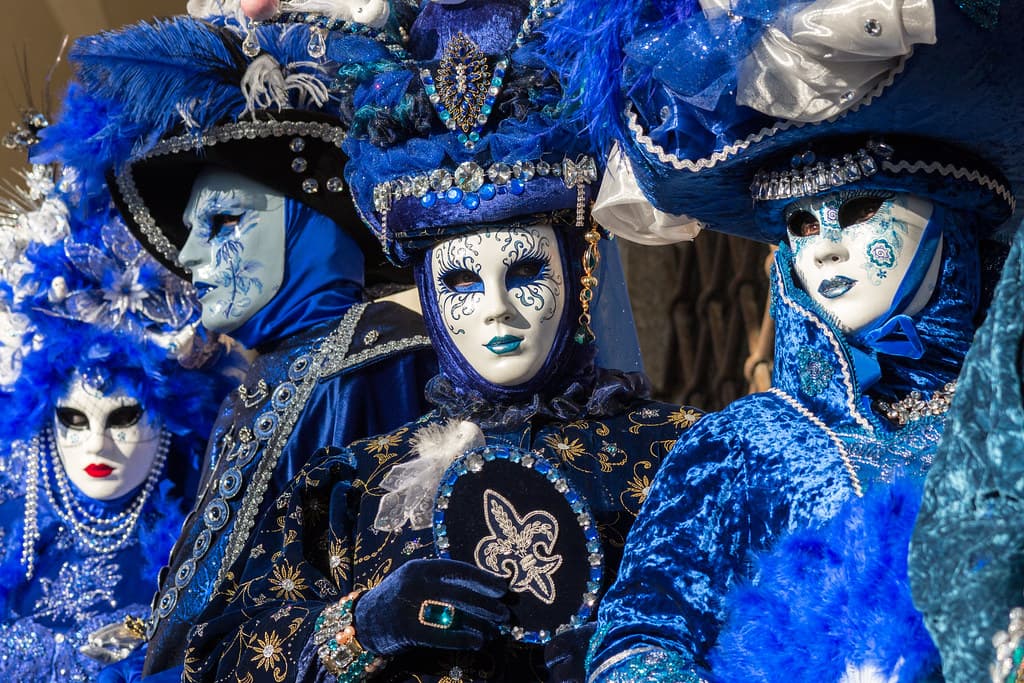
Today's carnival is a mix of public spectacle and private elegance. Each edition has a theme and a program of events across the city, while the real heart for many is the costumes: elaborate eighteenth-century gowns, capes and tricorn hats, and masks such as the bauta, the moretta and the long-beaked medico della peste, the plague doctor.
Behind a mask, Venice once let everyone be someone else. It still does, for a few weeks a year.
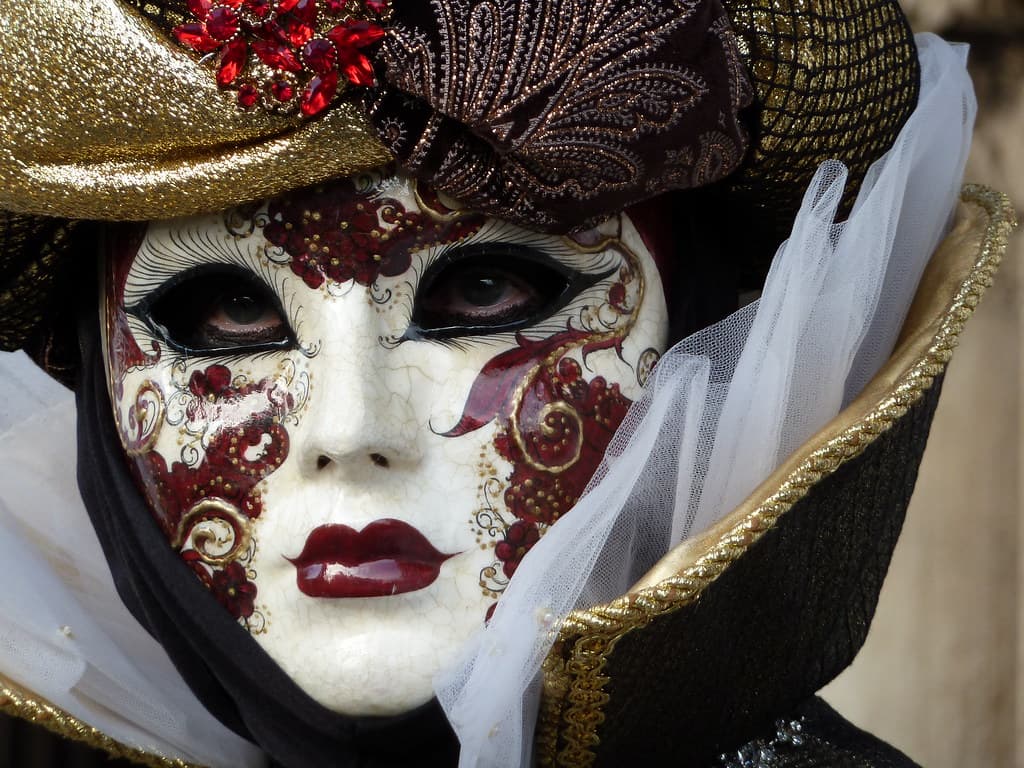
A traditional carnival mask in Venice
Photo by fra_cas / flickr · CC BY 2.0
What to expect
The program changes each year, but several events recur and anchor the festival.
Opening weekend
Venetian water parade
The festival opens with a procession of decorated traditional boats on the Grand Canal (on the first Sunday in 2026, running from the Dogana to the Rialto), followed by food and music along the water.
Mid-carnival Sunday
Flight of the Angel
A costumed performer descends on a cable from the bell tower of San Marco into the crowded piazza at noon, the signature moment of the festival. In 2026 it fell on the second Sunday, February 8.
Daily
Costumes in the piazza
Masked figures gather in Piazza San Marco and around the city, posing for photographs. Shows, concerts and contests for the best costume fill the main stage.
Evenings
Balls and dinners
Private masked balls in palazzos, from relatively accessible dinners to lavish black-tie events, require advance tickets and costumes.
Shrove Tuesday
Flight of the Lion and closing
The Flight of the Lion drops from the bell tower at noon, followed by the final costume parade and the closing of carnival on the last day before Lent.
Planning your trip
Getting there
Venice is reached by train to Santa Lucia station or by flights to Marco Polo airport, with water buses and boats into the historic center. Inside the city everything is on foot or by vaporetto. Weekends during carnival are extremely crowded, especially around San Marco and the Rialto, while weekdays are noticeably calmer. Venice's carnival wraps up on Shrove Tuesday, just as Cologne Carnival does, and Basel Fasnacht begins six days later in the same Easter-linked calendar, so the three can share one winter trip through Europe.
Where to stay
Book accommodation early; carnival weekends are some of the busiest of the year. Staying on the Lido, Giudecca or in Mestre on the mainland is cheaper. Balls and gala dinners sell out well in advance and often require full period costume.
What it costs
Watching is largely free: the water parade, the Flights and the costume contests in the piazza cost nothing. The money goes elsewhere. Masked balls and gala dinners run from a few hundred euros to several thousand per person, and renting a full costume adds hundreds more (one 2026 guide lists €350–850). Hotel rates climb for carnival weekends, which is why the Lido and Mestre are worth a look.
Go like you know
- Buy or rent your mask from a traditional workshop rather than a souvenir stall. Handmade papier-mâché masks are works of art.
- Rent a full costume from a specialist atelier if you plan to attend a ball. Book fittings well ahead.
- Try frittelle, sweet fried dough balls filled with cream or raisins, and galani, crisp ribbons of fried pastry dusted with sugar, both carnival treats.
- Always ask before photographing costumed people up close; most are delighted, but it is a courtesy.
- Visit on a weekday if you can. You will have more space, better photos and a far calmer city.
- Take the vaporetto along the Grand Canal at dusk during carnival week, when lit palazzos and costumed passengers make the ride feel like a scene from another century.
Frequently asked questions
Do I need to wear a costume?
No, but even a simple mask helps you join in. Many visitors wear a mask and a cape; others go all-out. Costumes are expected at balls and some private events. Rentals are available from specialist shops, and traditional mask workshops sell beautiful handmade pieces.
Are carnival events free?
Most public events, such as the water parade, the Flight of the Angel and costume displays in the piazza, are free to watch, though access may be limited when areas are full. Balls, dinners and some shows are ticketed and can be expensive. Check the official program for each event.
When is the best time to go?
The opening weekend and the final days are the most exciting but also the busiest. Weekdays during carnival offer a calmer experience with plenty of costumes and events. If you want a ball, plan your dates around the one you wish to attend.
How crowded does Venice get?
Very, especially on weekends and around Piazza San Marco. Authorities may restrict access to the square. Plan to arrive early for big events, explore quieter neighborhoods in between, and use the vaporetto to reach different parts of the city.
Can I visit Venice's islands during carnival?
Yes, and it is a good break from the crowds. Burano, with its colored houses, and Murano, famous for glass, are reachable by vaporetto and are much calmer than San Marco. Some carnival events also take place on the islands, so check the program for activities beyond the main piazza.