What is Basel Fasnacht?
The Basler Fasnacht is Switzerland's largest carnival and one of its most distinctive. Basel is Protestant, and unlike Catholic carnivals such as Venice Carnival and Cologne Carnival, which end on Shrove Tuesday, its Fasnacht begins on the Monday after Ash Wednesday, a date that goes back to a second, later carnival date of the medieval church calendar and predates the Reformation. For exactly 72 hours, the city puts work aside and gives itself to music, satire and lantern light.
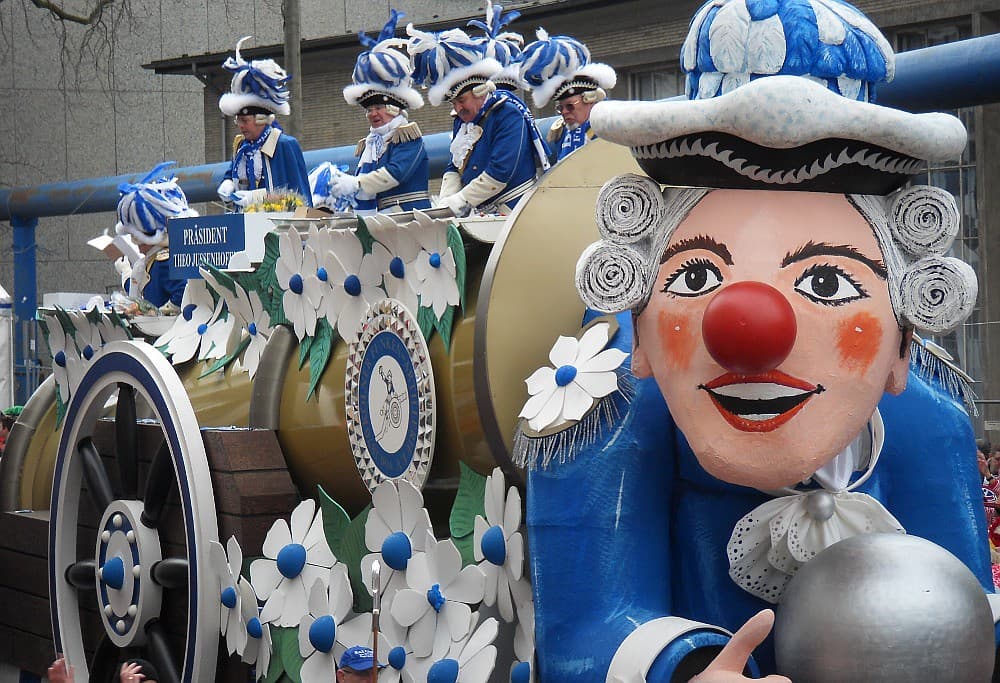
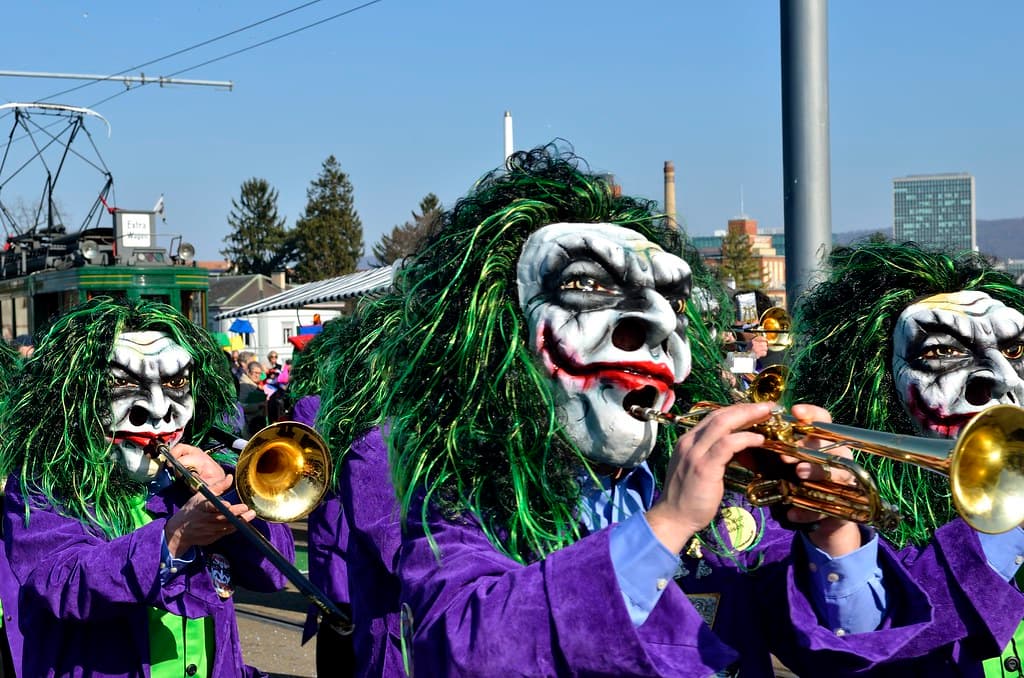
The heart of Fasnacht is the cliques, groups of fife players and drummers who practise for months and march in elaborate costumes and masks, the larve. Each clique chooses a theme, a sujet, usually a satirical take on local, national or world events, and expresses it in costumes, giant lanterns and verses. The humor is sharp, and much of it is written in Basel dialect.
Alongside the cliques come the Guggenmusik brass bands, playing deliberately off-key, and individual masked figures who recite satirical verses in restaurants and bars. In 2017, UNESCO recognized Basel Fasnacht as intangible cultural heritage. For locals, it is not a tourist show but the city's own celebration, and visitors are welcome as long as they respect its customs.
Three days a year, a famously orderly city hands itself over to piccolos, satire and lantern light.
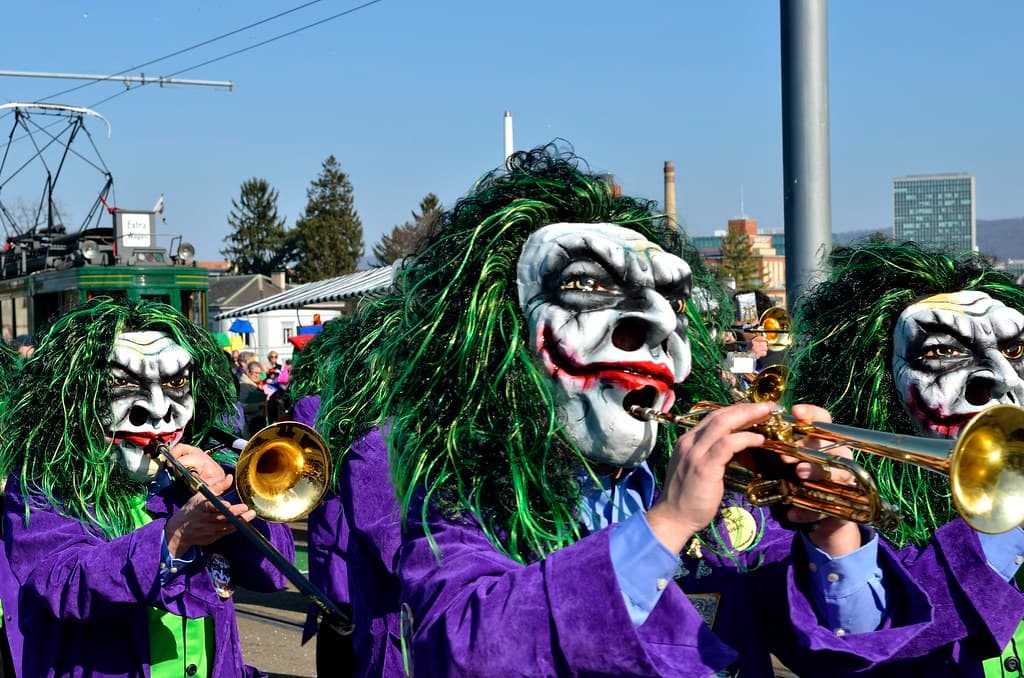
A masked brass band marching at Basel Fasnacht
Photo by Noel Reynolds / flickr · CC BY 2.0
What to expect
Fasnacht's 72 hours have a set structure, with famous moments that draw crowds and long hours of improvisation in between.
Monday 4am
Morgestraich
The lights go out and the cliques march with their lanterns through the old town, playing the Morgestraich march. Afterwards, restaurants serve flour soup and onion tarts.
Monday & Wednesday afternoon
Cortège
The great parades: cliques, bands and floats follow a long route through the city, throwing oranges, sweets and confetti, called räppli.
Tuesday
Children and lanterns
A day for children's and family parades. The cliques' giant lanterns stand on display on the Münsterplatz from Monday evening until Wednesday morning, lit up after dark.
Tuesday night
Guggenmusik concerts
Brass bands take over the Marktplatz, Barfüsserplatz and Claraplatz with concerts that last into the night.
Thursday 4am
Ändstraich
The cliques play a final march, and at four in the morning Fasnacht ends, exactly 72 hours after it began.
Planning your trip
Getting there
Basel sits where Switzerland, Germany and France meet, with rail links in all three directions and an international airport on the French side. The old town is compact and walkable, and public transport beats driving, since parking is restricted during the festival. Basel's carnival starts about a week after Cologne's street carnival ends, so the two fit comfortably into one rail trip.
For Morgestraich, be in the old town well before four in the morning to find a place along a route. The Marktplatz and Barfüsserplatz fill quickly; quieter corners such as the Leonhardskirchplatz are worth trying.
Where to stay
Base yourself in or near the old town, on either side of the Rhine, so you can walk to Morgestraich in the dark rather than depend on an early connection. Rooms in Basel are expensive and fill early for these three days, so book as soon as your dates are firm; if the city is full, the German and French towns just over the border are close by rail.
What it costs
Watching is free: the Morgestraich, the Cortège and the Guggenmusik concerts cost nothing. The one expected spend is the Blaggedde, which in 2026 sold for CHF 10 in copper, CHF 20 in silver, CHF 50 in gold and CHF 100 for the bijou editions. The organizers also say the badge is valid as admission to the Münsterplatz lantern exhibition, so buy one before you go. The rest of the bill is Basel itself: Swiss hotel, restaurant and drink prices, plus a bowl of flour soup at dawn.
Go like you know
- Eat Mehlsuppe, a brown flour soup, and Zwiebelwähe, onion tart, after Morgestraich. Many restaurants open in the early morning for this.
- Go to the Münsterplatz on Tuesday evening to see the giant lanterns up close; it is the best way to read the satire.
- Listen to the Schnitzelbängg, verse singers who perform satirical songs in restaurants in the evenings; even if you cannot follow the dialect, the atmosphere is unforgettable.
- Walk the side streets at night, where small groups of pipers and drummers wander independently, playing until dawn.
- Respect the masks. Cliques march anonymously, and recognizing a friend is part of the fun, but never lift a mask.
Frequently asked questions
When does Basel Fasnacht take place?
It starts on the Monday after Ash Wednesday at exactly four in the morning and ends 72 hours later, at four in the morning on Thursday. Because its timing depends on Easter, the dates change every year, falling in February or early March.
Can visitors join the parades?
No, the parades and processions are reserved for registered cliques and groups who practise for months. Visitors are welcome as spectators, shouldn't wear costumes or masks, and should respect the rules. Buying a Blaggedde badge shows support and is appreciated by locals.
Is Morgestraich worth getting up for?
Absolutely. It is the most famous and moving moment of Fasnacht: the city in darkness, illuminated only by the lanterns, with piccolos and drums echoing through medieval streets. Arrive early, dress warmly and plan a nap later in the day.
What should I wear?
Wear warm, practical clothes and comfortable shoes, since you will be standing outside for hours, often in freezing temperatures. Do not wear a costume or mask unless you belong to a clique. A hat and gloves are essential for the early-morning Morgestraich.
Where should I stand for Morgestraich?
Anywhere in the old town along the cliques' routes works, but popular spots such as the Marktplatz and Barfüsserplatz fill early, while the Leonhardskirchplatz tends to be calmer. Arrive well before four, stand to the side, and let the cliques pass. Narrow lanes offer the most atmospheric views.