What is Owara Kaze no Bon?
Owara Kaze no Bon (おわら風の盆) is a masked bon-dance held every September 1–3 in Yatsuo, a sloped hillside district of Toyama City. The tradition is over 300 years old, believed to date to 1702, and it is tied to the wind. Kaze no Bon means roughly "Bon festival of the wind," and the dance is widely understood as an offering to appease the wind and to pray that the typhoons of early autumn spare the rice crop before harvest. The "Bon" echoes the late-summer season covered under Obon, but the mood here is closer to a hushed vigil than a party.
What makes it unlike almost any other Japanese festival is the silence. There are no shouts, no amplified music, no rowdy stalls setting the tempo. Eleven neighborhood troupes (Nishishinmachi, Higashishinmachi, Suwamachi, Kagamimachi, Kamishinmachi, Higashimachi, Nishimachi, Imamachi, Shitashinmachi, Tenmancho and Fukushima) each dance their own routes through their own streets, in their own yukata, with distinct choreography and even different song lyrics. Crowds watch quietly as the processions pass old merchant houses, because the unamplified kokyū and shamisen are easily drowned out.
That kokyū, a rare bowed string instrument seldom heard elsewhere in Japanese folk music, is the festival's secret. It gives Owara its haunting, mournful sound, closer to a lament than a celebration, and it is why so many people travel across Japan to stand in a dark lane and say nothing at all.
Most festivals ask you to join in. This one asks you to go quiet and listen.
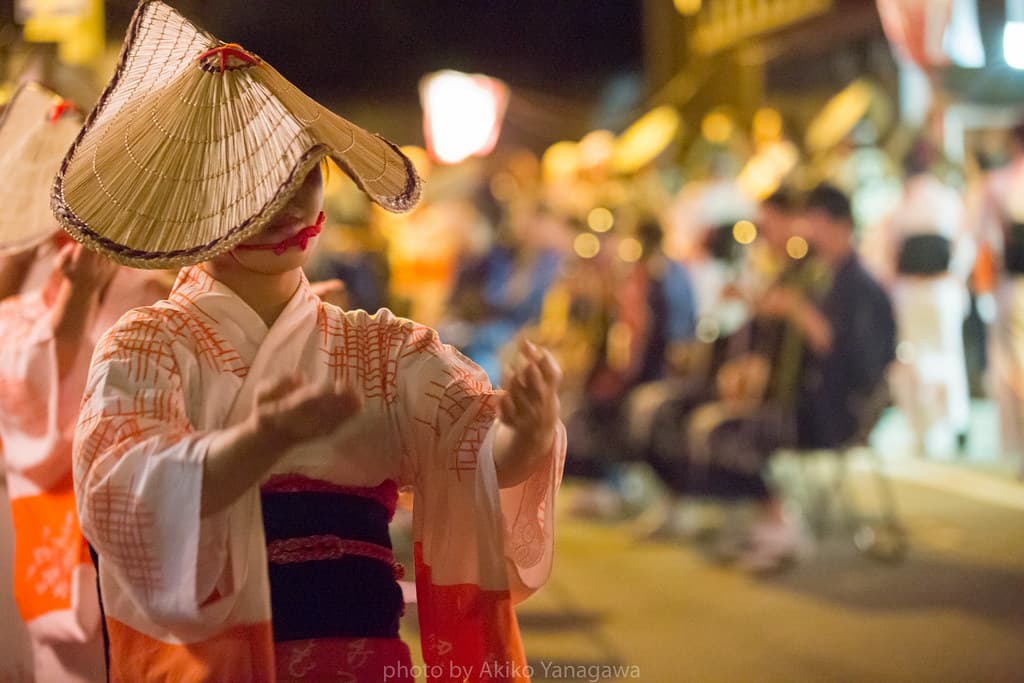
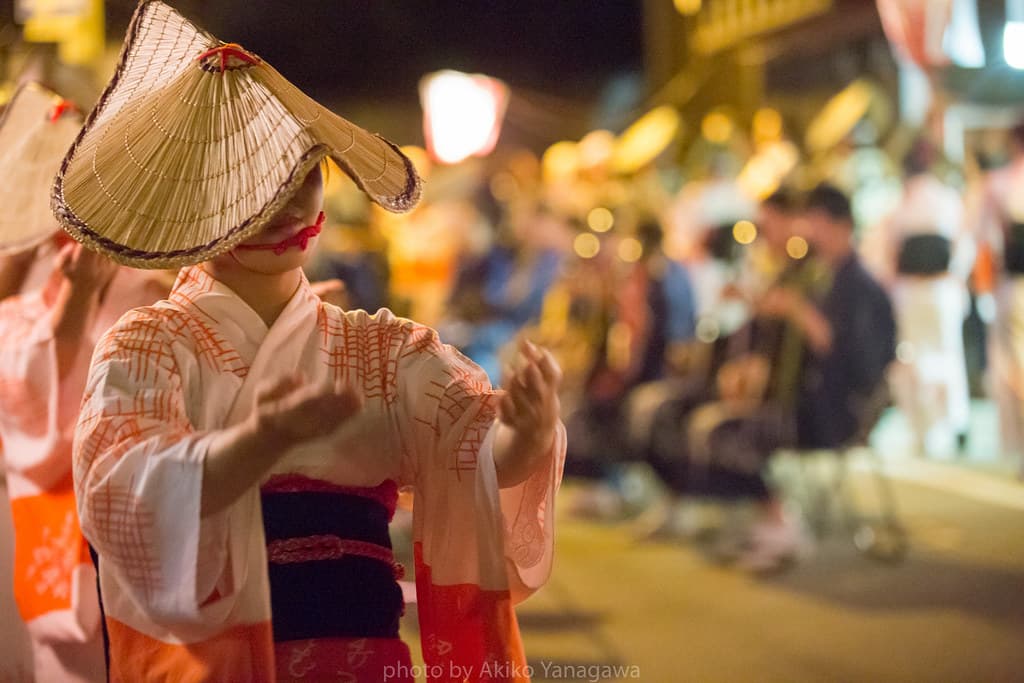
A dancer at Owara Kaze no Bon
Photo by akikoyanagawa / flickr · CC BY-SA 2.0
What to expect
The main nights run from 5 p.m. to 11 p.m. on the first two nights, and from 7 p.m. on the last, but the truth of Owara often happens after that, when the crowds thin and neighborhoods keep dancing for themselves. The late-August zenyasai preview nights that once let the towns perform in rotation are suspended for the time being because of a shortage of people to run them, so the main three nights are now the festival.
Sep 1–2
The main nights
Street processions (machi-nagashi) run from 17:00 to 23:00. There is no single central venue: dances seem to begin spontaneously in the lanes, so you wander and let them find you. Crowds peak from around 19:00 and are at their thickest in the middle of the evening.
Sep 3
The final night
The last evening starts later, from 19:00, and runs to 23:00. When the official program ends, locals often keep dancing unscheduled into the small hours; after 11 p.m. the streets grow quieter, darker and more mysterious, and for many that is the most beautiful part of all.
Planning your trip
Getting there
Getting to Yatsuo is simple. From Toyama Station, take the JR Takayama Line to Etchū-Yatsuo Station, about 25 to 30 minutes, then walk around 30 minutes uphill to the old town. A free shuttle runs on festival days between the Yatsuo Sports Arena and Yatsuo Bridge, and vehicles are barred from the venue streets, so build in extra time. The same Takayama Line carries on into Gifu Prefecture to Takayama, home of the Takayama Festival, if you want to extend the trip. Expect a queue for transport on the way out, and plan to leave very late or very early.
Where to stay
Where you sleep is the real puzzle. Yatsuo itself has very few places to stay, and rooms nearby can fill as much as a year ahead, so most visitors base themselves in Toyama City hotels 25 to 30 minutes away by train. Treat lodging as the thing you lock in first, and book as early as you can.
What it costs
Watching the street processions is free, and the train is cheap. Weather is the other variable: early September in Toyama is late summer, with warm evenings that cool after dark and a chance of typhoon-season rain, so pack light layers and rain gear (a raincoat works better than an umbrella in the crowd). The one paid option is indoor stage seating at the Hikiyama Exhibition Hall, which cost ¥4,000 in 2026 for an unreserved seat and had sold out for all three nights when we checked. If you want one, buy early. Parking, if you drive, was ¥3,000 per car in 2026, but the train is easier.
Go like you know
- Keep your voice low during performances and skip flash photography. The unamplified strings are the whole point, and staff will notice.
- Don't block the narrow sloped lanes; step aside for the troupes and follow staff instructions in the tighter streets.
- If you can't linger for the late dancing, the paid stage seating (¥4,000 in 2026, unreserved, at the Hikiyama Exhibition Hall) is the way to be sure of a view, but it sells out, so book it as soon as it opens.
- Bring a flashlight, comfortable shoes and food and drink: shops in the old town are limited, and lanes are dark and steep.
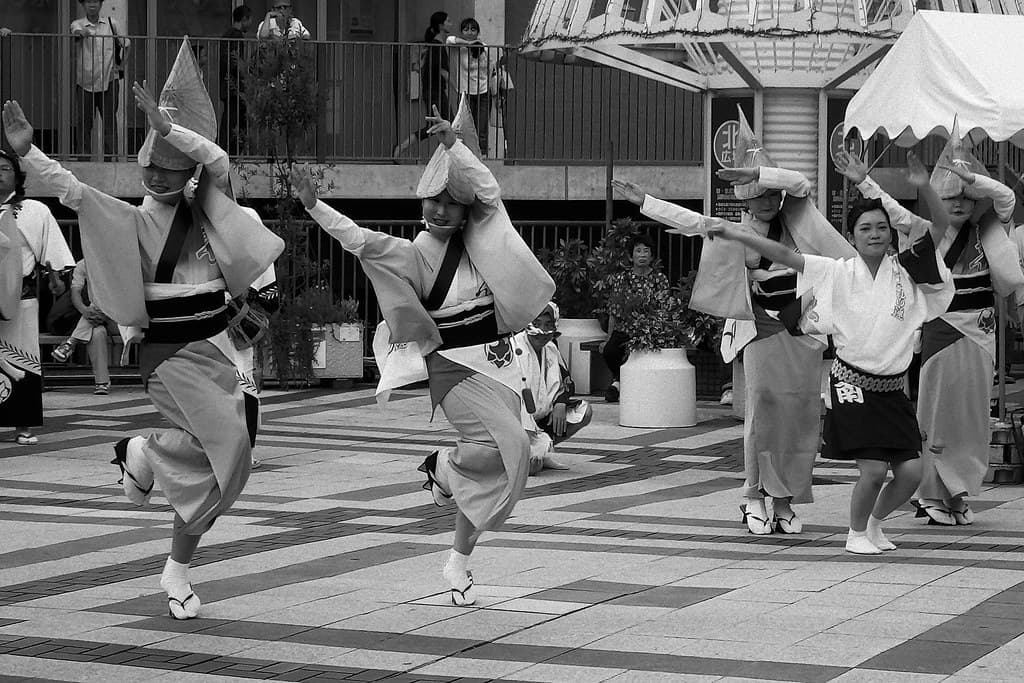
- If you like bon dances loud and joyful, Awa Odori in Tokushima, in mid-August, is the opposite pole to Owara's hush.
Frequently asked questions
Do I need a ticket to see Owara Kaze no Bon?
No. Watching the street processions is free: you simply walk the lanes of Yatsuo and follow the music. The only paid option is unreserved stage seating at the Hikiyama Exhibition Hall (¥4,000 in 2026, and sold out for all three nights), useful if you want a guaranteed view rather than wandering the crowded streets.
When is the best time to arrive each night?
Aim for 16:00–17:00 to catch the early processions in soft light, before the mid-evening peak. If you can, stay past the 23:00 program end: the unscheduled late-night dancing, once the crowds thin, is quieter and far more atmospheric than the busy evening hours.
How many days do I need?
One night captures the essence, since the same neighborhoods dance across all three days. If you can spare more, the September 3 finale runs latest into the night, and a second evening lets you follow a different town's dance. A bed is the hard part, so arrange lodging first.