What is Awa Odori?
Awa Odori (阿波おどり) is one of Japan's biggest dance festivals and the loudest, most joyful expression of Obon, the midsummer season when ancestral spirits are welcomed home. "Awa" is the old name of Tokushima province; "odori" simply means dance. Each year around a thousand ren (dance troupes) parade through the city's streets and stages, dancing to a relentless two-beat rhythm hammered out on taiko drums, shamisen, flutes, and bells.
The origin story locals like best dates it to 1586, when the feudal lord Hachisuka Iemasa threw open the sake stores to celebrate the completion of Tokushima Castle, and the whole town danced until it couldn't stand. Historians point to older Obon folk-dance roots, and the festival's name only took hold in the prewar Showa era, but four centuries of practice have settled the argument in the streets rather than the archives.
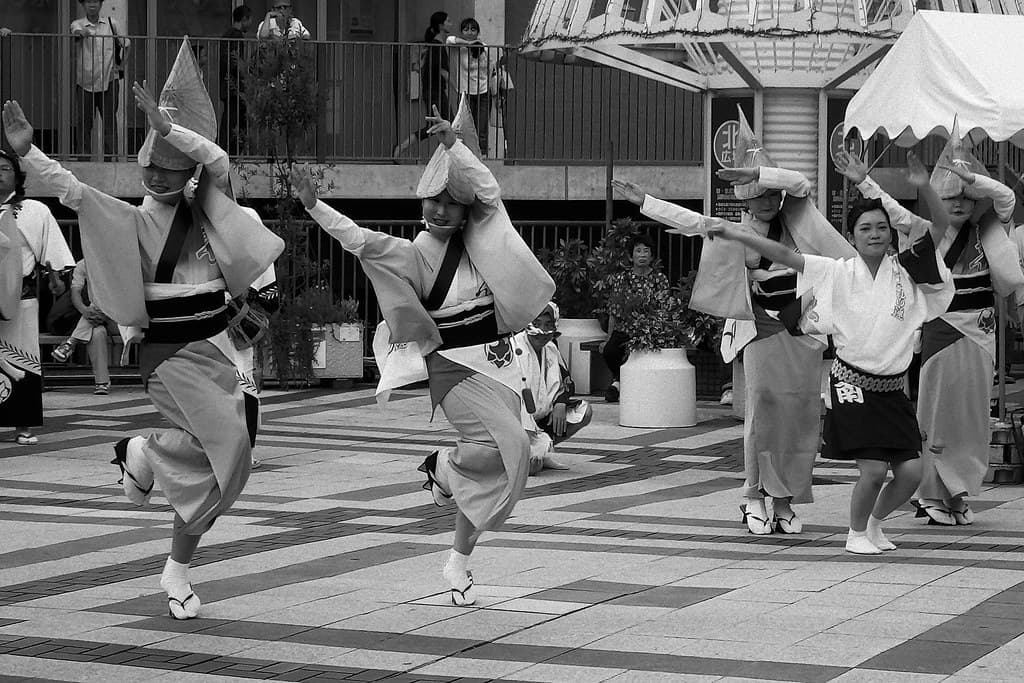
The dance itself splits by tradition: women dance the elegant onna odori in formation (fingertips high, straw amigasa hats folded like half-moons) while the men's otoko odori is a low, loose-limbed, comic crouch. Both are harder than they look, which is half the joke of the famous chant: 踊る阿呆に見る阿呆、同じ阿呆なら踊らにゃ損々 ("the dancers are fools and the watchers are fools; being the same kind of fool, you lose out if you don't dance").
The dancers are fools and the watchers are fools, so you may as well dance.
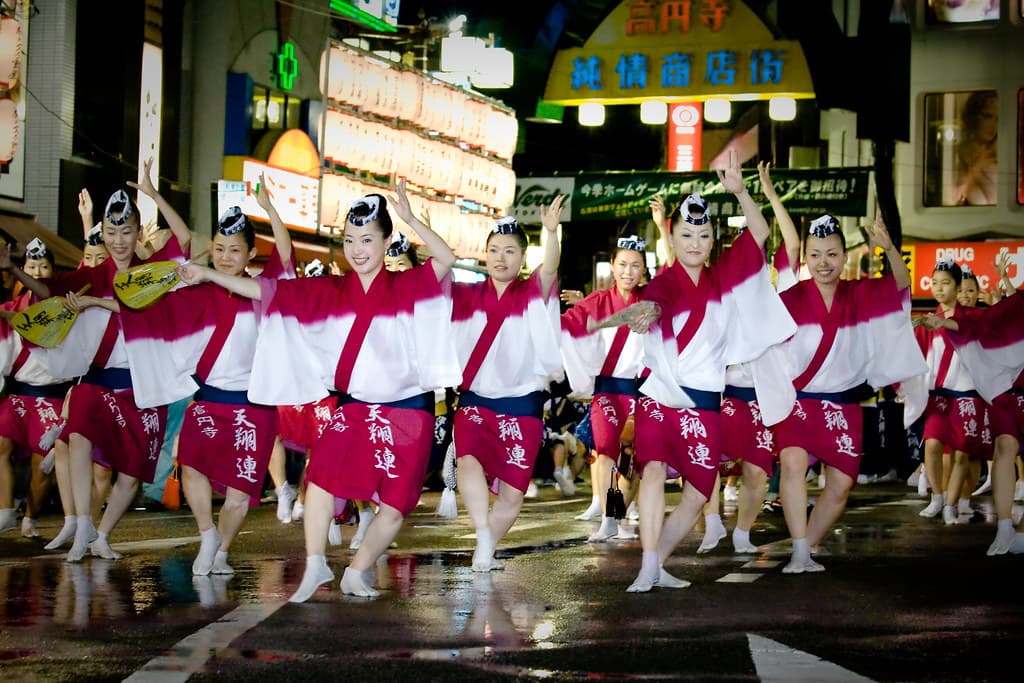
Dancers in matching costumes moving in formation through the street
Photo by Manatee マナティ / flickr · CC BY 2.0
What to expect
Aug 11
The opening stage
In 2026 the festival opened with a ticketed indoor show at Asty Tokushima, where about 600 dancers from the two main dance associations performed three times that day. The street dancing itself starts the next evening, so this is a bonus night rather than a necessity.
Aug 12–14
The main nights
In the evening the three paid enbujo (stadium-style stands) run two shows, 6:00 to 7:40pm and 8:20 to 10:00pm, and the famous professional ren dance there. The free venues, among them the Ryogoku Honcho street stage and the dance plazas by the Shinmachi and Ryogoku bridges, carry the rowdier, more local energy. During the day, ticketed indoor shows run at Awagin Hall.
Aug 15
The last night and the so-odori
The final evening closes with the so-odori, a massed dance of the association ren at the Minami-Uchimachi stand: roughly a thousand dancers on one stretch of street. After it, the barriers blur, and the city dances itself home.
Planning your trip
Getting there
Tokushima is the point of Shikoku closest to the mainland. The highway bus from Osaka or Kansai Airport takes about 2 hours 45 minutes, and from Kobe about 1 hour 50 minutes, crossing the Akashi Kaikyo and Naruto bridges. There's no Shinkansen, so the bus is the normal way in; book that leg along with your bed.
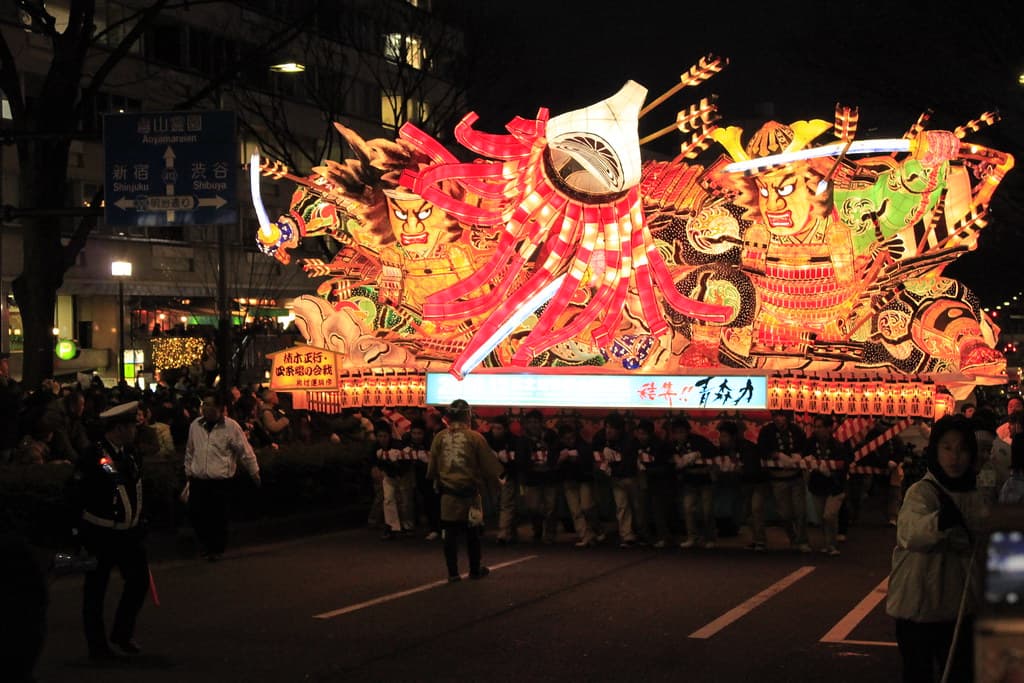
The city is compact and walkable, with the main venues near the station and the river. If you can't find a bed, Takamatsu is about 1 hour 15 minutes away on the Limited Express Uzushio, and Naruto is closer still. Check last departures before committing to a late return. Awa Odori overlaps with Obon travel across Japan, so expect full trains. It also follows Aomori Nebuta (August 2–7) by about a week, if you want to chain a northern and a Shikoku festival into one August trip.
Where to stay
Tokushima's hotel stock is small for a festival this size, and central hotels take bookings early: Daiwa Roynet Hotel Tokushima Ekimae, for instance, opened bookings for the 2027 festival on September 1, 2026, and other hotels open in January or later. Plan to book months ahead.
If the center is full, base yourself in Naruto or Takamatsu and commute in by train or bus.
What it costs
Watching from the free streets costs nothing. The paid enbujo stands are worth one night for the choreographed spectacle of the famous ren. In 2026, seats ran from ¥1,000 (unreserved) to ¥6,000, plus a ¥15,000 premium section, and prices moved with demand under a dynamic-pricing system. Buy through the official site, Ticket Pia, or Seven-Eleven kiosks. The other nights, go free-range: the unpaid streets are where Awa Odori stops being a show and becomes a town dancing.
Go like you know
- Plan around the evenings: the paid stands start at 6pm and the free plazas open around the same time. Daytime is for the indoor Awagin Hall shows and a long lunch, so pace yourself.
- Eat early or graze at the yatai stalls, so you aren't hunting for a table when the dancing starts.
- The two-beat rhythm is called zomeki. Learn to clap it and locals will grin at you all night.
- Sudachi, Tokushima's tiny green citrus, goes on everything. Squeeze it on the grilled chicken from the stalls and thank us later.
- The stands run until 10pm, so a same-night return to Osaka is a stretch. Stay the night; the after-hum in the izakayas is part of the festival.
Frequently asked questions
Do I need tickets for Awa Odori?
No, most of the festival is free street viewing. Tickets (¥1,000–6,000 in 2026, plus a ¥15,000 premium section) are only for the enbujo grandstand sections, worth it for one night of top-tier ren choreography. The free zones are livelier and where spectators end up dancing.
Can tourists actually join the dancing?
Yes, officially and enthusiastically. The niwaka-ren accepts anyone, every evening, with a short lesson from a veteran dancer. There is no fee, costume, or booking, and the organizing committee itself runs it, so it isn't a tourist add-on.
How far in advance should I book accommodation?
Aim for as early as hotels allow: some central hotels open the September before, others in January, and the walkable center fills months ahead. If you're late, look at Naruto or Takamatsu and commute in by train or bus, checking the last departures first.