What is Gion Matsuri?
Gion Matsuri began in 869, when a plague swept the capital and terrified residents erected 66 halberds (hoko), one for each province of old Japan, and paraded the deity of Yasaka Shrine through the city in portable shrines, begging the vengeful spirits behind the epidemic to relent. The rite worked, or seemed to, and it stuck. Held as an annual event since 970, it now ranks with Tokyo's Kanda Matsuri and Osaka's Tenjin Matsuri as one of Japan's three greatest festivals.
What most visitors come to see are the floats, but the religious heart of the festival is the Mikoshi Togyo. On the evening of July 17, three portable shrines carry Yasaka's deities down into downtown Kyoto, where they rest at the Otabisho for a week before returning to the shrine on July 24. The towering, tapestry-draped floats are, in a sense, an escort for the gods, and a moving museum of centuries-old textiles that has earned them the nickname of a parade of galleries.
The festival's shape has changed with the times. The two grand processions, Saki Matsuri on July 17 and Ato Matsuri on July 24, were once merged into a single parade (in 1966, during Japan's rapid-growth era), when a divided event felt like a luxury. The separate Ato Matsuri procession was only restored in 2014, after 48 years, returning the festival to its older two-part rhythm.
Sixty-six halberds, one for every province, raised to beg a plague to lift, and never put down since.
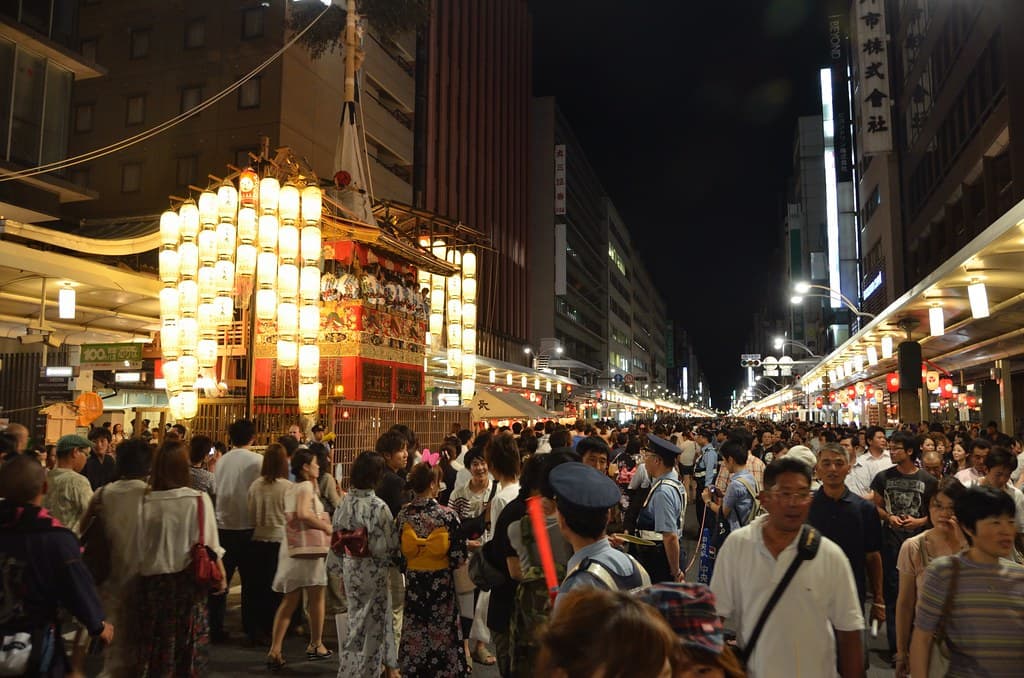
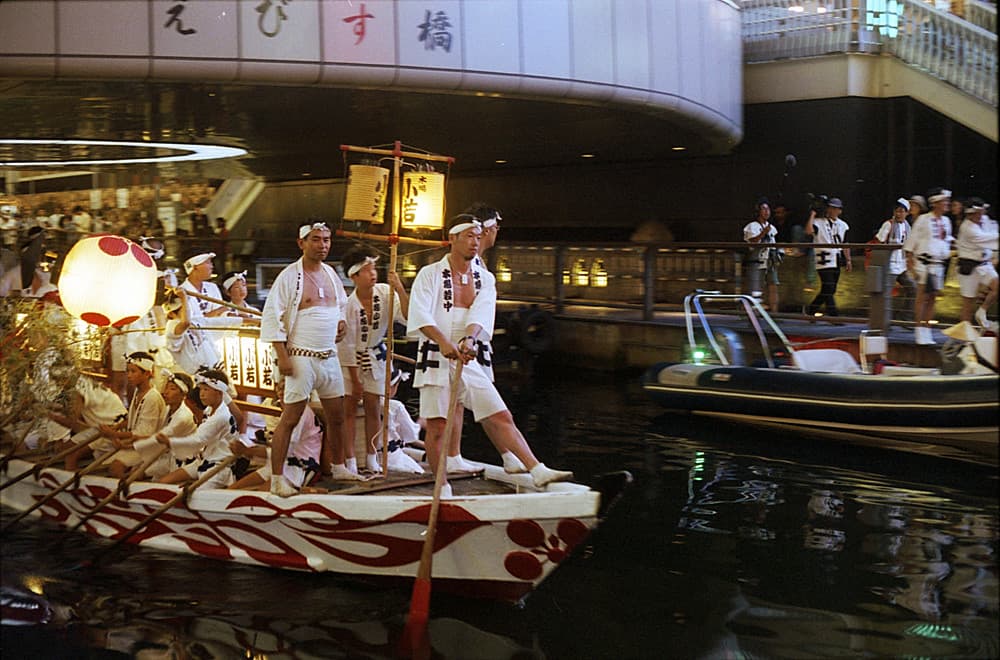
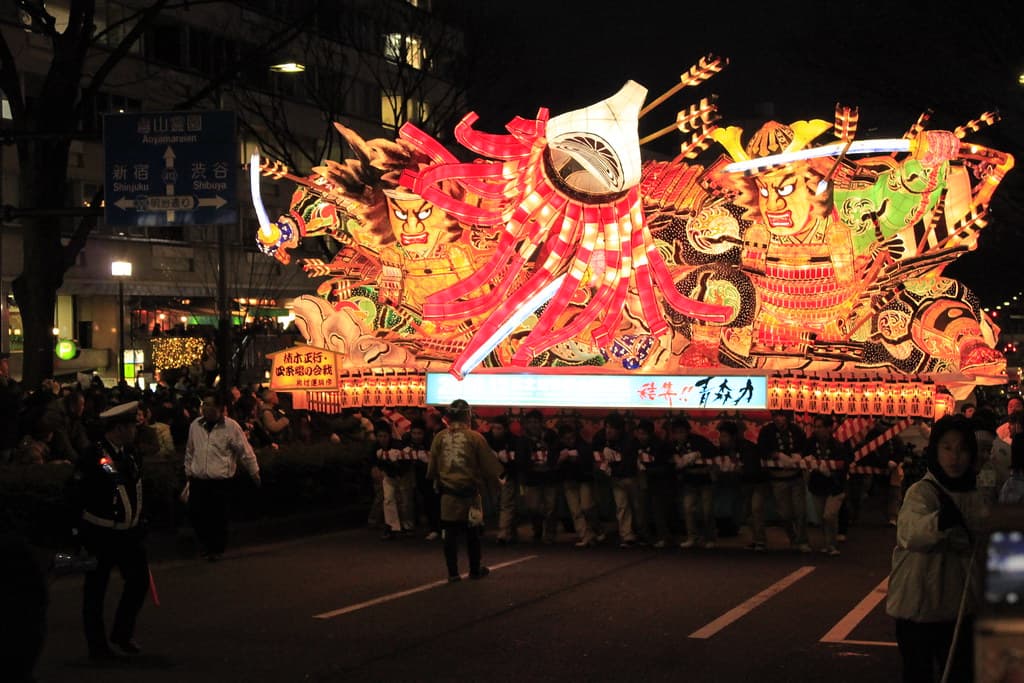
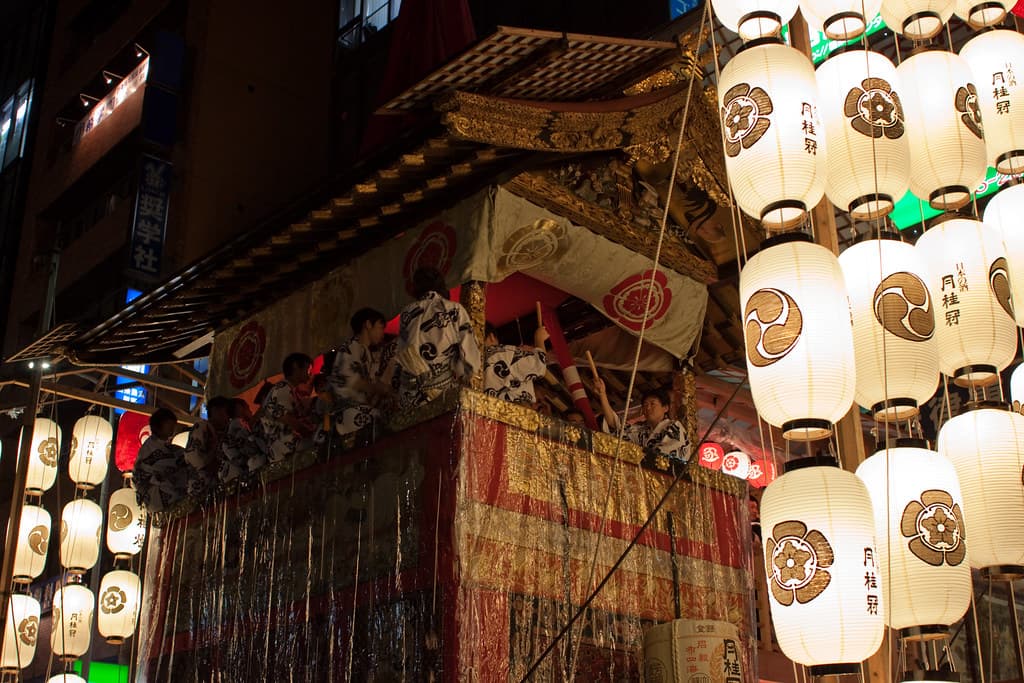
A Gion Matsuri float glowing at the end of a crowded Kyoto street on a festival evening
Photo by kubotake / flickr · CC BY 2.0
What to expect
The month runs to a fixed script, an unbroken sequence of rites that builds toward two great mornings.
Jul 2
The float lottery
The kujitori-shiki draws lots to set the order of the procession, the first formal act of the month, and a reminder that even in festivity the sequence is sacred.
Jul 10
Lantern procession and purification
A lantern procession and a shrine purification rite prepare the way for the portable shrines to come.
Jul 14–16
Yoiyama eves (Saki Matsuri)
The machiya-lined float streets glow with lanterns. On July 15 and 16, Shijo and Karasuma streets close to vehicles from 18:00 until around 23:00 and fill with food stalls. Locals stage the Byobu Matsuri, opening their homes to display heirloom folding screens. Go in the evening, and consider a yukata.
Jul 17
Saki Matsuri: the grand procession
Twenty-three floats leave Shijo-Karasuma at 9:00 AM, the tallest hoko reaching about 25 meters, roughly the height of an eight-story building. That evening, three portable shrines carry Yasaka's deities into downtown.
Jul 21–23
Yoiyama eves (Ato Matsuri)
A quieter, more intimate second round of lantern nights before the smaller procession, less crowded than the mid-month peak. The pedestrian-only streets and stalls of the first round are not repeated on these nights.
Jul 24
Ato Matsuri and the shrines' return
Eleven floats run the route in reverse at 9:30 AM, and the portable shrines return to Yasaka Shrine, closing the circle opened on the 17th.
Jul 28 & 31
Cleansing and closing
The portable shrines are ritually cleansed on July 28, and a final plague-god shrine ceremony on July 31 formally ends the festival.
Planning your trip
Getting there
The festival zone is central Kyoto, around Shijo, Kawaramachi, and Oike streets, easily reached by subway, bus, or on foot, with no special transport needed. On July 15 and 16, Shijo-dori and Karasuma-dori close to vehicles from 18:00 until around 23:00, with pedestrians kept to the left side of Shijo, so leave extra time and expect thick station crowds on procession mornings and Yoiyama nights. Official digital GPS maps of the float streets are published for both rounds of eves. If your dates allow, note that Osaka's Tenjin Matsuri falls on July 24–25 in the neighboring city: the Ato Matsuri procession runs on the morning of the 24th, leaving the 25th for Osaka's main day.
Where to stay
Base yourself anywhere in central Kyoto, near Shijo and Kawaramachi, and you can walk to everything. The one thing that requires planning far ahead is the bed: Kyoto lodging surges around the mid-July peak, and travel guides advise booking months out, since the central location that makes the festival effortless is exactly the stock that goes first.
What it costs
Watching is free: the processions and Yoiyama nights cost nothing. For a guaranteed spot, paid reserved seats on Oike-dori are sold ahead through Ticket Pia and convenience stores. For 2026 they ran ¥6,000–8,000 for general seating on both processions, up to ¥125,000–155,000 for premium seats on July 17. Lodging is the real cost, with rates around the mid-July peak running well above normal.
Go like you know
- Free viewing lines Shijo, Kawaramachi, and Oike streets. For a guaranteed spot, reserved seats on Oike-dori go on sale in early summer, so buy them well before your trip.
- Download the official digital GPS festival maps before Yoiyama, since they make navigating the closed-off float streets far easier in the crush.
- Come to Yoiyama hungry on July 15 and 16. Those evenings double as a street-food crawl, with stalls filling the traffic-free float streets around Shijo-Karasuma; the Ato Matsuri eves are quieter and stall-free on the main streets.
- Seek out the Byobu Matsuri on the eve nights: private machiya owners display heirloom folding screens through open doorways, a quiet counterpoint to the lantern-lit bustle outside.
- Watch the floats round a corner rather than on the straightaway: the turning of these top-heavy giants, wrenched by teams on ropes, is the hardest and most thrilling maneuver of the day.
Frequently asked questions
Do I need a ticket to see Gion Matsuri?
No. The processions are free to watch from Shijo, Kawaramachi, and Oike streets, and Yoiyama nights are open to all. Paid reserved seats on Oike-dori (¥6,000–8,000 general, up to ¥155,000 premium on July 17 in 2026) only buy a guaranteed, comfortable spot, worth it if you want a certain view without the crowd scramble.
Should I go on July 17 or July 24?
Both are grand processions with the same towering floats. July 17 (Saki Matsuri) is the larger, more famous event with 23 floats and heavier crowds; July 24 (Ato Matsuri) has 11 floats, runs the route in reverse, and draws far fewer people. For a calmer first visit, choose the 24th.
When should I book accommodation?
Months ahead. Travel guides urge reserving festival-week lodging well in advance, since mid-July rates surge and central Kyoto hotels sell out early. Book the moment your dates are firm, and prioritize a central base so you can walk to the float streets rather than fighting crowded transport.