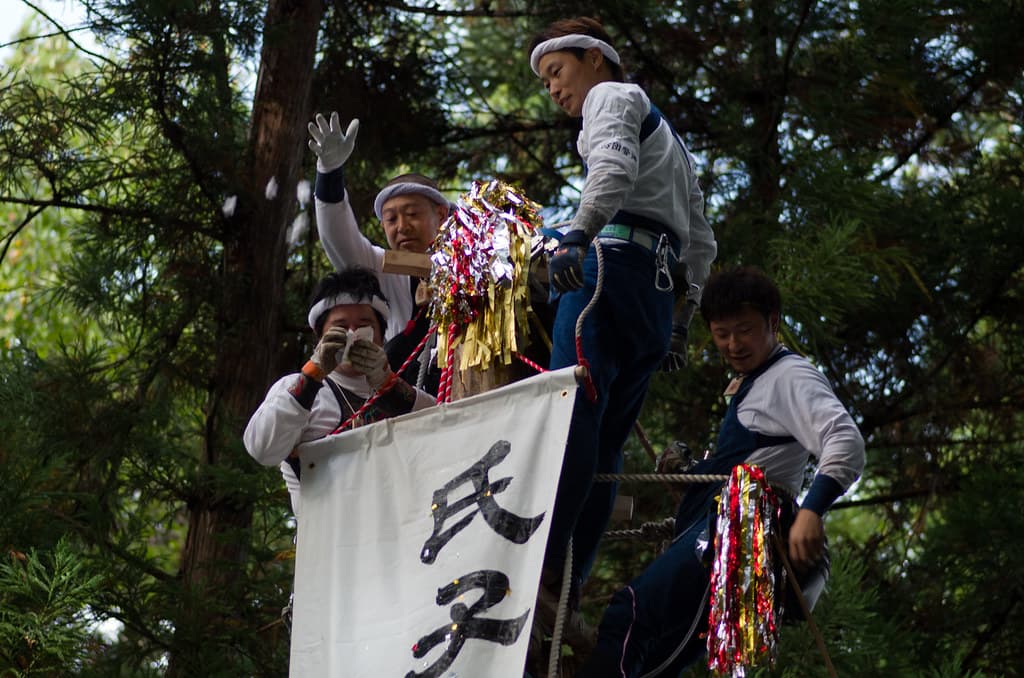
What is Onbashira?
Onbashira (御柱祭) is held once every six years (locals count seven, inclusively), in the years of the Tiger and the Monkey in the Chinese zodiac, at Suwa Taisha, one of the oldest shrine complexes in Japan. Suwa Taisha has four shrines around Lake Suwa in Nagano Prefecture, two on each side of the lake, and each shrine has four sacred pillars, onbashira, standing at its corners.
During the festival, all sixteen pillars are renewed. Huge fir trees are cut in the mountains and hauled by hand to the shrines, where they are raised in place of the old pillars. The tradition is popularly reckoned to be about 1,200 years old, and its origins are linked to ancient beliefs about trees, mountains and the gods of Suwa.
The festival is famous for its danger. The most dramatic moment is the kiotoshi, when logs are sent down steep slopes with men riding on top. Another highlight is the kawagoshi, when logs are dragged across a river. Injuries are not rare, and deaths have occurred in the festival's history, most recently reported in 2016. For the communities of Suwa, taking part is a matter of pride, faith and identity, passed down through generations.
Every six years, a mountain comes down to the shrine, one tree at a time.
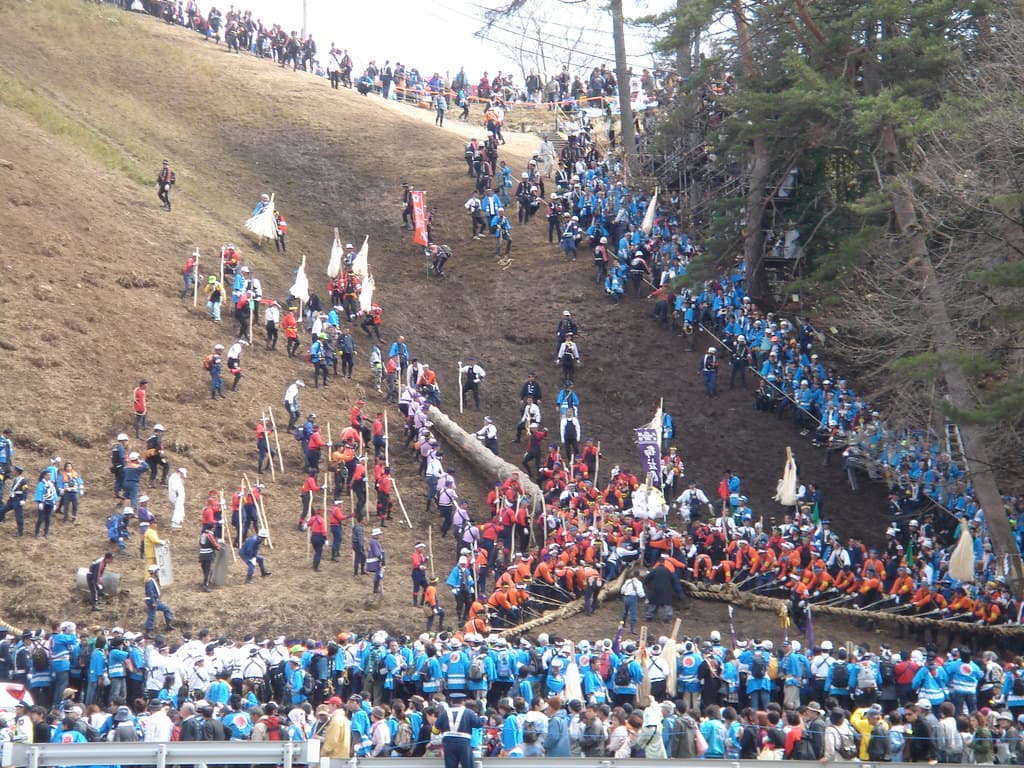
Teams haul a giant fir log down the slope during Onbashira
Photo by shibainu / flickr · CC BY 2.0
What to expect
The festival is divided into two parts, held in April and May.
April
Yamadashi
The logs are brought down from the mountains toward the shrines. This stage includes the kiotoshi slopes and river crossings, drawing huge crowds.
May
Satobiki
The logs are pulled through the towns to the shrines in festive processions with costumes, music and performances, and then raised as pillars, with men riding the tops as they lift.
Festival year
Smaller shrines
Smaller shrines around the Suwa region also stage pillar events of their own, on a quieter scale. Ask the local tourist office which ones are on during your visit.
Planning your trip
Getting there
From Tokyo, the JR Limited Express Azusa runs from Shinjuku to Chino in about two hours, Kamisuwa in about two hours fifteen to twenty, and Shimosuwa a few minutes later. From Nagoya, take the Shinano limited express to Shiojiri and change for a short local ride. If you are flying into Tokyo, the city's Sanja Matsuri lands in the third weekend of May, after the Satobiki weekends have finished.
Onbashira is a festival on the move, and the main events are a reasonable walk from the local stations: the Kamisha Yamadashi slope is roughly 1.5 km from Chino Station, while the Shimosha kiotoshi slope is about 4 km uphill from Shimosuwa. Buses and taxis are of limited use because of crowds and road restrictions, and parking near the action is scarce and pricey, so leave the car behind.
Where to stay
The towns around Lake Suwa, including Kamisuwa, Shimosuwa and Chino, have hotels and ryokan with hot springs, and they fill up quickly for festival weekends, so book as soon as the dates are announced. Matsumoto, to the north, has more options and a famous castle, and it is twenty to forty minutes from Suwa by train depending on the service. For a second festival on the same trip, the Takayama Festival takes place on April 14 and 15, soon after the Shimosha Yamadashi weekend.
What it costs
Watching from public areas is free, and the Azusa from Shinjuku to Kamisuwa cost about ¥5,980 one way in recent listings. Reserved viewing seats are the main paid extra and are priced high, so decide in advance whether the fixed view is worth it. Between festival years you can still visit the four shrines of Suwa Taisha and see the pillars standing at their corners, enjoy Lake Suwa's hot springs, and catch the big lake fireworks on August 15.
Go like you know
- Try Suwa's local specialties: grilled eel (unagi) and crunchy wakasagi (smelt) from the lake, and sake from the Go-kura group of five breweries near Kamisuwa Station, which offer tastings.
- Walk the shisha-mairi, the pilgrimage to all four shrines for stamps, and spend a night with the pillars standing at the corners.
- Relax in the hot springs around Lake Suwa after a day of festival crowds.
- Learn the festival chant, Yoisa!, which you will hear as people pull the logs.
- Ask locally whether any smaller shrines are holding pillar events during your trip.
- Watch the pillar-raising, tateonbashira, at the end of Satobiki, when the logs are hauled upright by ropes with riders still clinging to the top.
Frequently asked questions
When is the next Onbashira?
Onbashira is held every six years, in the years of the Tiger and the Monkey. The most recent was in 2022, and the next is in 2028, followed by 2034. The Yamadashi takes place in April and the Satobiki in May, with dates announced by the shrines in advance.
Can visitors take part?
The main events are run by local residents and their teams, and riding the logs is strictly for experienced local participants. Visitors are spectators. If you hope to join a rope team on the Satobiki route, ask the organizers or the Suwa tourist office well ahead, because participation rules can change from one edition to the next.
Is Onbashira dangerous to watch?
For spectators who follow instructions and stay behind barriers, it is generally safe, but crowds are dense and moving logs are heavy and unpredictable. Follow staff instructions, keep children close, and avoid standing on slopes or near the paths of the logs.
What can I see between festival years?
You can visit the four shrines of Suwa Taisha and see the pillars standing at their corners. The area also offers hot springs, a paved loop of about sixteen kilometers around Lake Suwa for walking or cycling, and the Lake Suwa fireworks on August 15, a display that dates from 1949.
Where should I stay?
The towns around Lake Suwa, including Kamisuwa, Shimosuwa and Chino, have hotels and ryokan with hot springs, but they fill quickly in festival years. Matsumoto, twenty to forty minutes away by train, has more options and a famous castle. Book as soon as the festival dates are announced.