What is Holi?
Holi is the Hindu festival of spring, love, and the victory of good over evil, played out in two acts on the full moon of the month of Phalguna. The first evening is Holika Dahan: bonfires burn across North India, re-enacting the story of the demoness Holika, who tried to burn the devout child Prahlad and was consumed instead. The next morning is Rangwali Holi, the color play the world knows, rooted in the story of blue-skinned Krishna teasing his beloved Radha and painting her face to match his.
The lunar calendar moves the date each year. In 2026 the bonfires burned on March 3 and the colors flew on March 4; a leap month pushes 2027 to late March.
Krishna's own homeland, the Braj region around Mathura and Vrindavan, three to four hours from Delhi, celebrates hardest and longest, stretching Holi across more than a week: Lathmar Holi in Barsana and Nandgaon, where women drive off shield-carrying men with bamboo staves to gleeful crowds; flower-petal Holi at Vrindavan's Banke Bihari temple; and the widows' Holi at Gopinath temple, a modern tradition (it began in 2013) restoring color to women whom custom once condemned to lifelong white.
Don't be offended, it's Holi.
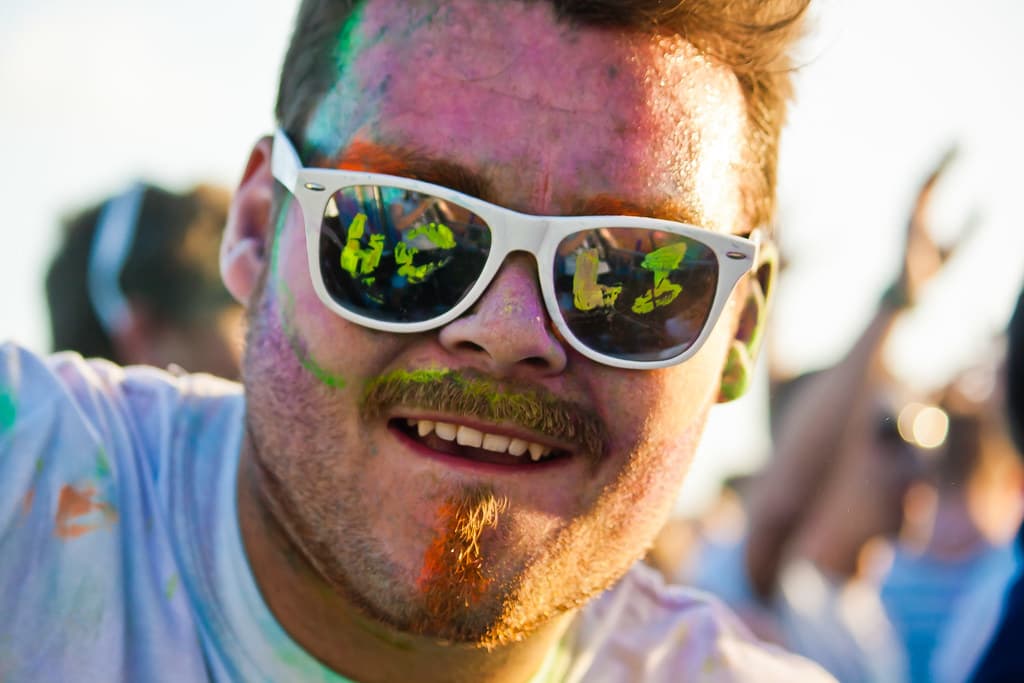
Colored powder on everything, face included
Photo by Kit4na / flickr · CC BY 2.0
What to expect
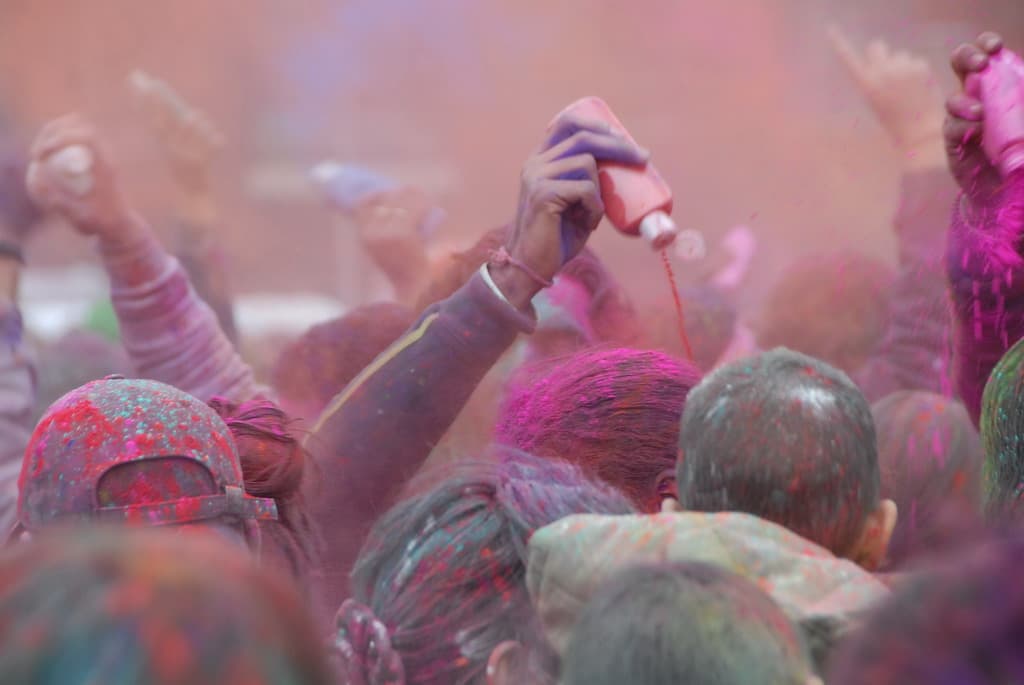
Rangwali Holi runs roughly sunrise to early afternoon. In Braj towns, lanes fill with gulal (colored powder), water balloons arc off rooftops, drums circulate, and sweets, especially gujiya, fried pastries stuffed with sweetened khoya, appear from every doorway. By early afternoon it simply stops: everyone bathes, dresses in fresh clothes, and spends the evening visiting family. The whiplash from anarchy to serenity is half the beauty.
The intensity varies enormously by venue. Temple courtyards and old-town lanes in Mathura and Vrindavan are the deep end: ecstatic, dense, rough at the edges. Delhi and Jaipur neighborhoods, hotel gardens, and organized events play a gentler game that families and first-timers may prefer.
Planning your trip
Getting there
Delhi is the practical gateway: Mathura has no airport of its own. By road it is about three hours over the Yamuna Expressway, longer on Holi traffic, and trains to Mathura Junction take roughly one and a half to three hours; Vrindavan is another 12 km on. Many travelers stay in Delhi, day-trip by pre-booked car or train, and play Holi morning-of. If you're chasing Lathmar Holi, note that it happens in Barsana and Nandgaon days before main Holi, so check the sequence for your year and build in the extra nights.
If Holi leaves you wanting more public soaking, Thailand's Songkran follows in mid-April.
Where to stay
For the full Braj experience, base in Mathura or Vrindavan and book early: tour-operator listings suggest rooms fill two to three months ahead for Holi week, and prices rise sharply. The lazier option is a Delhi base with a day trip. India in early March is warming but pleasant.
What it costs
Playing Holi in the street is free, and organic gulal is cheap. Train fares from Delhi to Mathura are listed from about ₹100 in general class up to about ₹1,500 in AC, and a hired car adds Yamuna Expressway tolls of roughly ₹415 to ₹450. Even with Holi-week premiums, Indian guesthouses are cheap by global standards.
Wear white throwaway clothes (tradition and best contrast), zip your phone into a waterproof pouch, and carry nothing you can't lose.
Go like you know
- Play in the morning, rest at noon. The celebration genuinely ends after lunch, and afternoon streets are surreal, quiet, and pink.
- Say yes to gujiya, thandai (the non-bhang kind unless decided otherwise), and every doorway invitation from families. That's the festival's true center.
- Photographers: a UV filter and a rain cover earn their price in ten minutes; gulal is glitter-grade invasive.
- The widows' Holi at Vrindavan's Gopinath temple is recent, moving, and open to respectful observers, so read about it before you go.
- Colors on strangers' terms only: locals heading to work in clean clothes are off-limits, and "no" means no even today.
- Pair the colors with fire. Valencia's Las Fallas (March 15 to 19) ends in a night of bonfires, and falls in the same month.
Frequently asked questions
Where is the best place to celebrate Holi?
Mathura and Vrindavan for maximum tradition and intensity; Delhi or Jaipur for a manageable, family-friendly version; organized events for guaranteed comfort at the cost of spontaneity. There's no wrong answer, only matching the venue to your appetite and your tolerance for crowds, noise, and being soaked head to toe before breakfast.
Is Holi safe for women travelers?
It can be, with planning: travel in a group, favor family courtyards and rooftop gatherings over the densest lanes, and leave the deep crowd when instinct says so. We flag this honestly because the harassment problem is real and widely reported; preparation, not avoidance, is our recommendation.
Do the colors come out of clothes and skin?
Skin, yes: within a day or two, faster with pre-applied oil. Clothes, no; wear sacrificial whites and plan to frame or bin them. Organic gulal behaves far better than the synthetic powders on both counts.