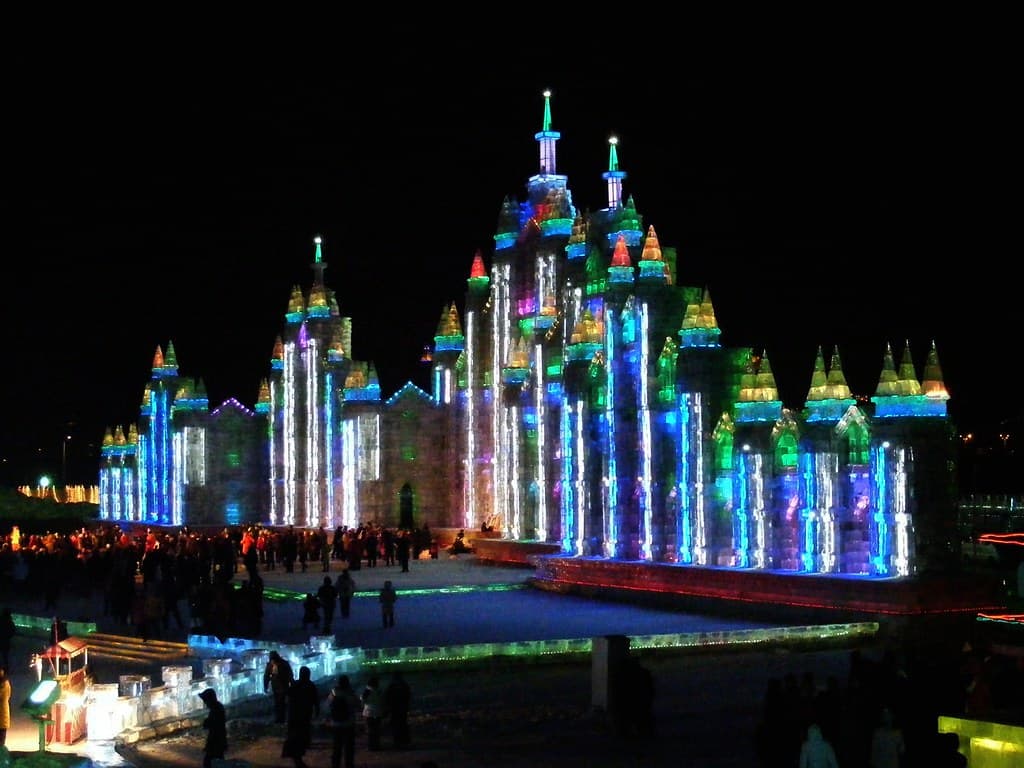
What is the Harbin Ice and Snow Festival?
Harbin sits in Heilongjiang, China's northernmost province, at about the same latitude as Montreal. Winters here are long and brutally cold, and for generations residents made the most of it by carving lanterns from ice: water frozen in buckets, hollowed out, and lit from inside with candles. Those simple ice lanterns grew into organized displays in the city's parks in the 1960s.
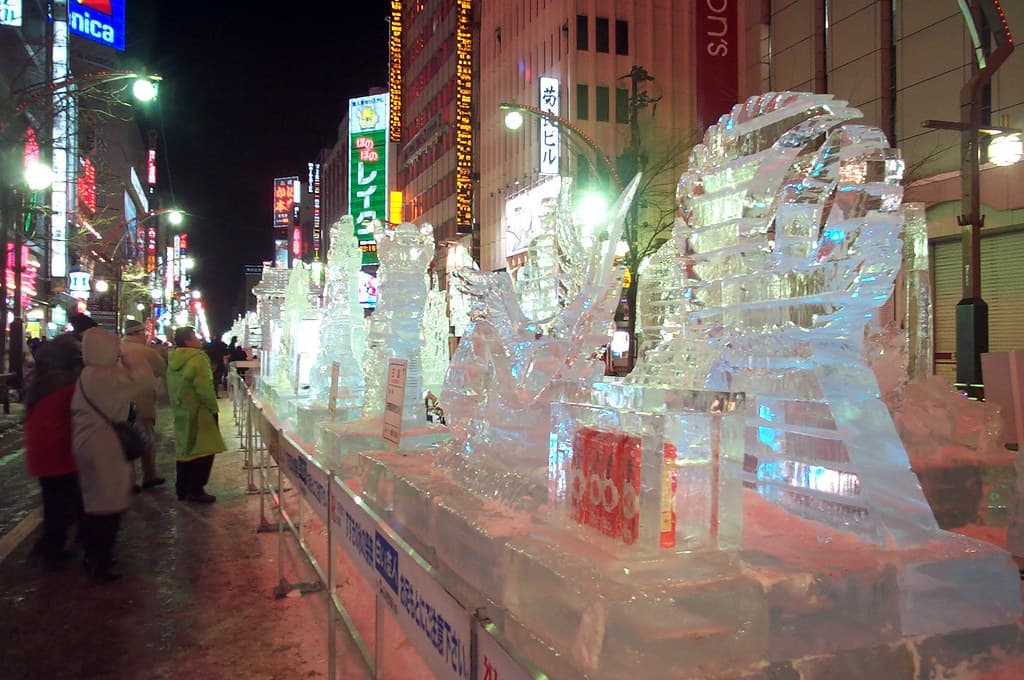
The official Harbin International Ice and Snow Festival was established in the 1980s and has grown into one of the largest winter festivals in the world. Its scale is staggering. Teams harvest enormous blocks of ice from the frozen Songhua River each winter (in recent years some has been stored for months before building starts), and workers and artists build entire temporary cityscapes from them in a matter of weeks: replicas of famous buildings, towers, mazes and slides, all embedded with colored lights.
The festival also reflects Harbin's unusual history. The city grew up around a Russian-built railway in the early twentieth century, and its old center still has onion domes, Art Nouveau facades and a long pedestrian street lined with European architecture. In winter, that architecture under snow makes Harbin feel unlike anywhere else in China.
Every winter, a river becomes a city of light, and every spring, it becomes a river again.
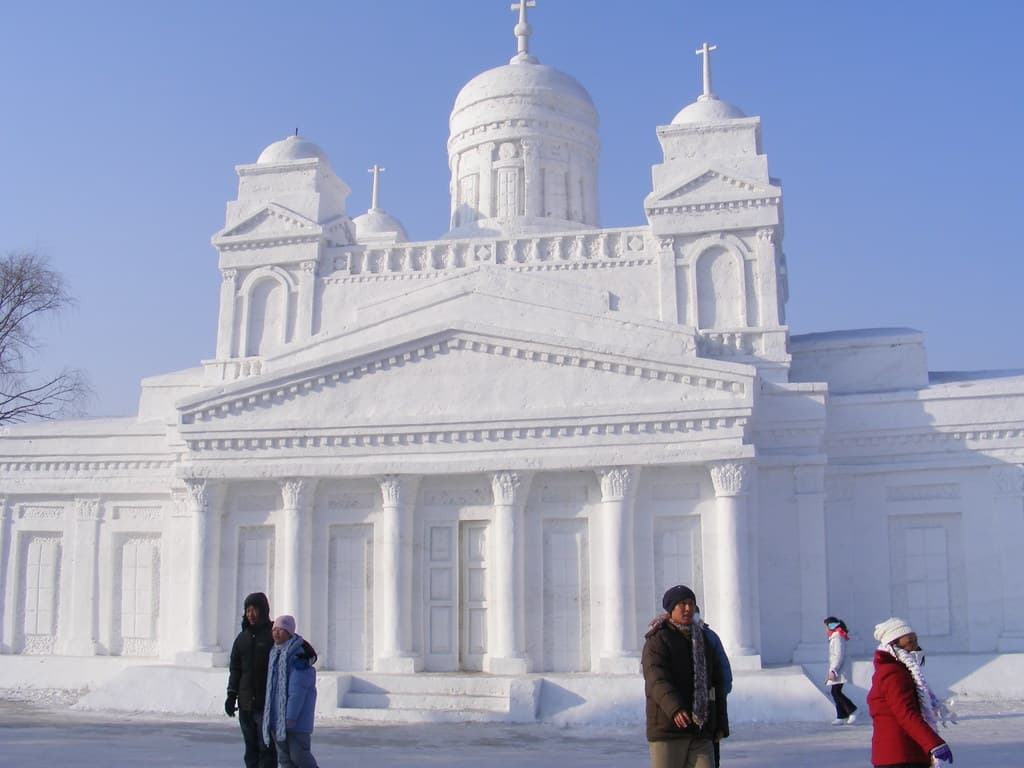
A church built entirely of snow at the Harbin Ice and Snow Sculpture Festival
Photo by Rincewind42 / flickr · CC BY 2.0
What to expect
The festival is spread across several sites, each with a different character. You can see the highlights in two or three days.
Late afternoon
Ice and Snow World
The headline site on the north bank of the Songhua River. Arrive before dark to see the ice sculptures in daylight, then stay as the lights come on and the buildings glow. Expect slides, ice bars and huge crowds at peak times.
Daytime
Sun Island snow sculptures
On Sun Island, artists carve towering sculptures from packed snow, including entries in an international competition. Best seen in daylight, when the detail is clearest.
Evening
Zhaolin Park ice lanterns
The oldest of the venues, closer to the city center, with smaller ice lanterns and sculptures in a more traditional style.
Any time
The frozen river and Central Street
Walk out onto the Songhua River for ice activities, then warm up along Central Street, the city's historic pedestrian avenue, with its European architecture and street food.
Planning your trip
Getting there
Harbin has an international airport and is connected by high-speed rail to Beijing (about five hours) and other major Chinese cities. The festival sites are spread out. The metro and festival-season shuttle buses can get you to the riverside and Central Street, but taxis or ride-hailing are the simplest way to link the venues.
Where to stay
The parks usually open in December and close in late February, depending on temperatures. Peak winter, from the traditional January 5 opening through Lunar New Year, brings the biggest crowds and the highest hotel prices, so book a couple of months ahead for those weeks. Weekdays in December and late February are quieter, though warmer weeks late in the season can cause early closures.
What it costs
Ice and Snow World, the headline site, charged 328 yuan for a standard adult ticket in the 2025–26 season, and the organizers have kept the price unchanged as the site grew. Sun Island and Zhaolin Park have their own admissions, generally lower, but reported prices vary by source, so check current ones. Hotels carry the real premium around the January opening and Lunar New Year; the rest of the bill, from street food to taxis, is modest by big-city standards.
Go like you know
- Visit Ice and Snow World in late afternoon so you see the sculptures both in daylight and lit up after sunset.
- Buy tickets in advance through official channels or reputable apps, especially for weekends and holidays.
- Try frozen fruit on sticks, tánghúlu, sold from street stalls, and the city's Russian-style sausages and bread along Central Street.
- Visit the Church of St. Sophia, a former Russian Orthodox cathedral, in the snow; it is one of the city's best-known landmarks.
- If you are brave, watch the winter swimmers who plunge into a hole cut in the frozen river; spectating is warm enough.
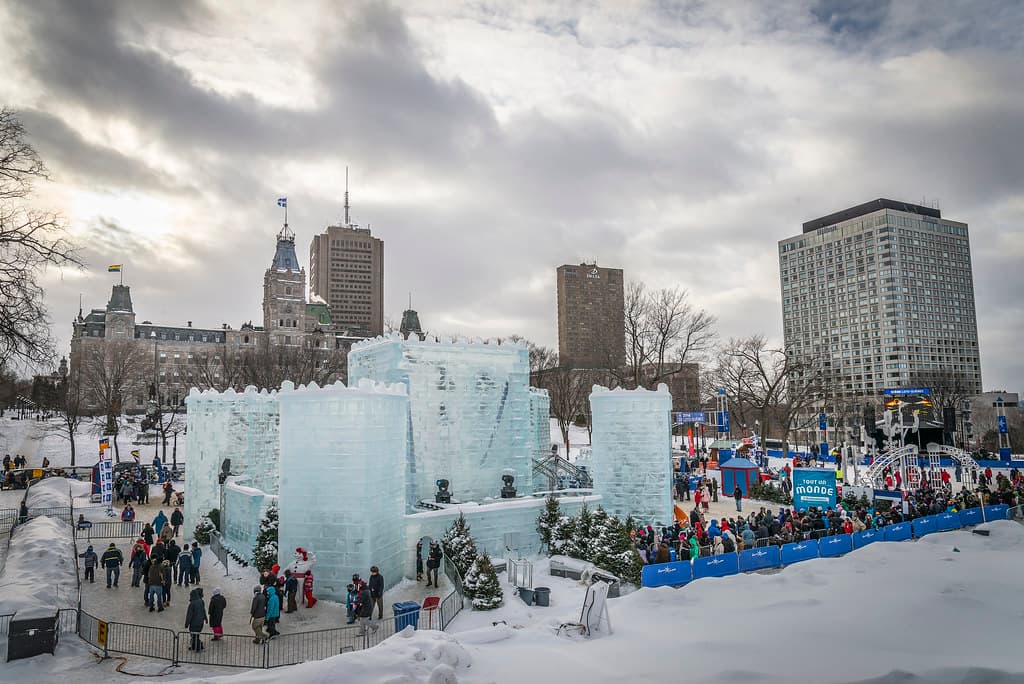
- Pair it with other winter festivals: February also brings the Sapporo Snow Festival in Japan and the Québec Winter Carnival in Canada.
Frequently asked questions
When is the best time to visit?
The festival sites typically open from mid or late December until late February. Early January brings the official opening and peak crowds. December weekdays and February outside the Lunar New Year holiday are calmer. Late in the season, warm weather can force early closures.
How cold is Harbin in winter?
Very cold. Daytime temperatures often sit well below freezing, and nights regularly drop below minus twenty degrees Celsius. Wind makes it feel colder. With proper layers, insulated boots and regular indoor breaks, it is manageable and part of the experience.
How much time do I need?
Two or three days are enough to see Ice and Snow World, Sun Island and Zhaolin Park and to explore the historic center. Add a day if you want to take part in ice sports or visit nearby ski areas, or to relax between cold outdoor sessions.
Is it suitable for children?
Yes, with preparation. Children enjoy the ice slides and colorful sculptures, but they lose heat faster than adults. Dress them in full winter gear, keep visits short, take frequent breaks indoors, and avoid the busiest days if you are visiting with a stroller.