What is St. Martin's Day?
Martin of Tours was a Roman soldier in the fourth century who, according to legend, met a freezing beggar at the gates of Amiens, drew his sword, cut his military cloak in half and gave one half away. That night, the story goes, he dreamed of Christ wearing the half-cloak. Martin left the army, became a monk and later Bishop of Tours, and died in 397. His feast day, November 11, became one of the great dates of the medieval calendar, marking the end of the harvest, the slaughter of animals for winter and the start of a winter fasting season.
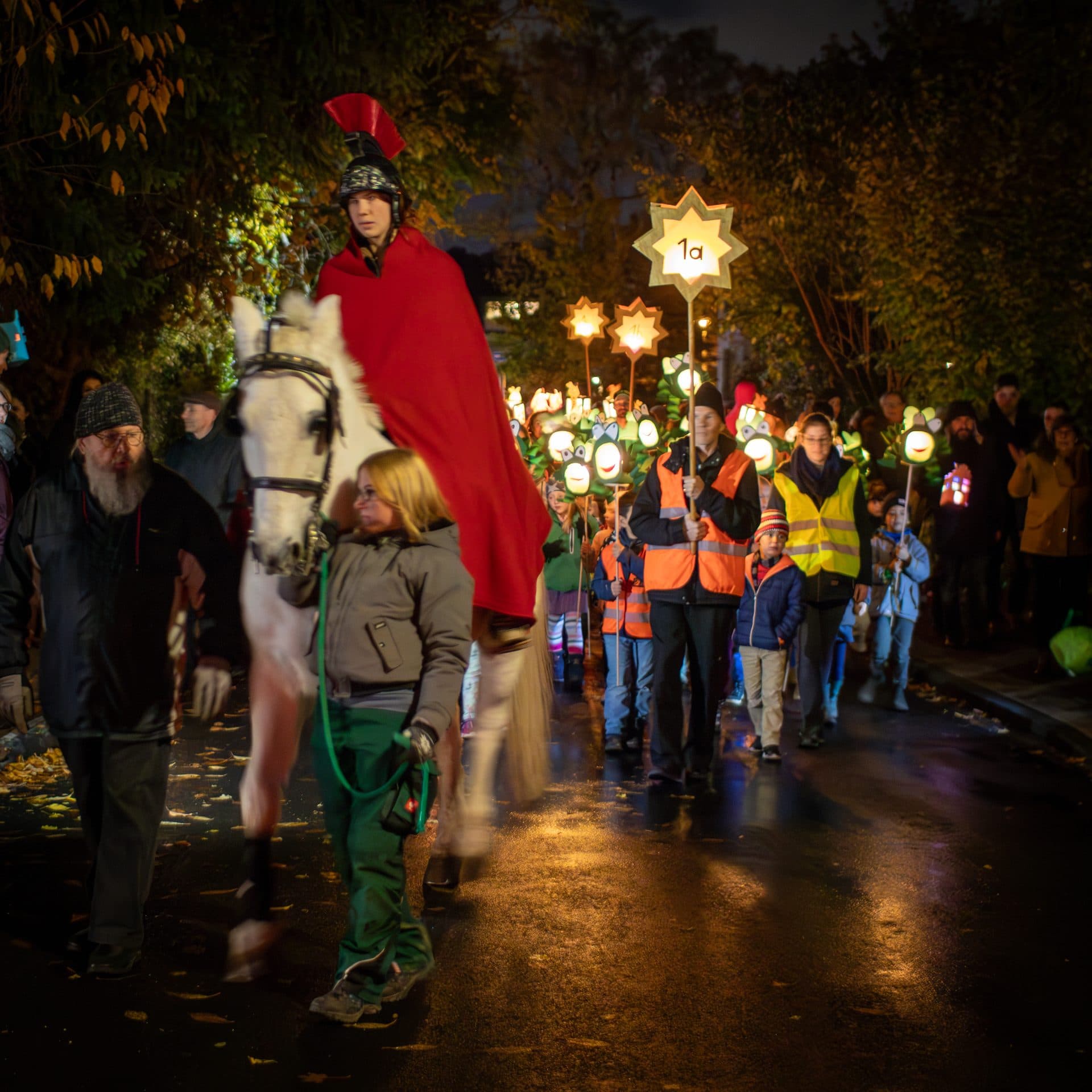
Across much of Central and Western Europe, the day is still celebrated, above all by children. In Germany, especially in the Rhineland, children make paper lanterns at school and walk them through the streets in the evening in a Martinszug, a lantern procession, singing traditional songs. Often a rider dressed as Martin, in a red cloak and helmet, leads the way, and the evening may end with a re-enactment of the cloak story and a large Martinsfeuer, a bonfire. The biggest processions draw thousands of people.
In the Netherlands and Flanders, children go from door to door with their lanterns on the evening of November 11, singing Sint-Maarten songs in exchange for sweets. Utrecht, whose cathedral is dedicated to the saint, holds its own parade. In Austria and southern Germany, the day is about food: roast goose, Martinsgans, served with red cabbage and dumplings, and the first taste of the new wine.
A soldier gave away half his cloak, and more than sixteen centuries later children still light the streets for him.
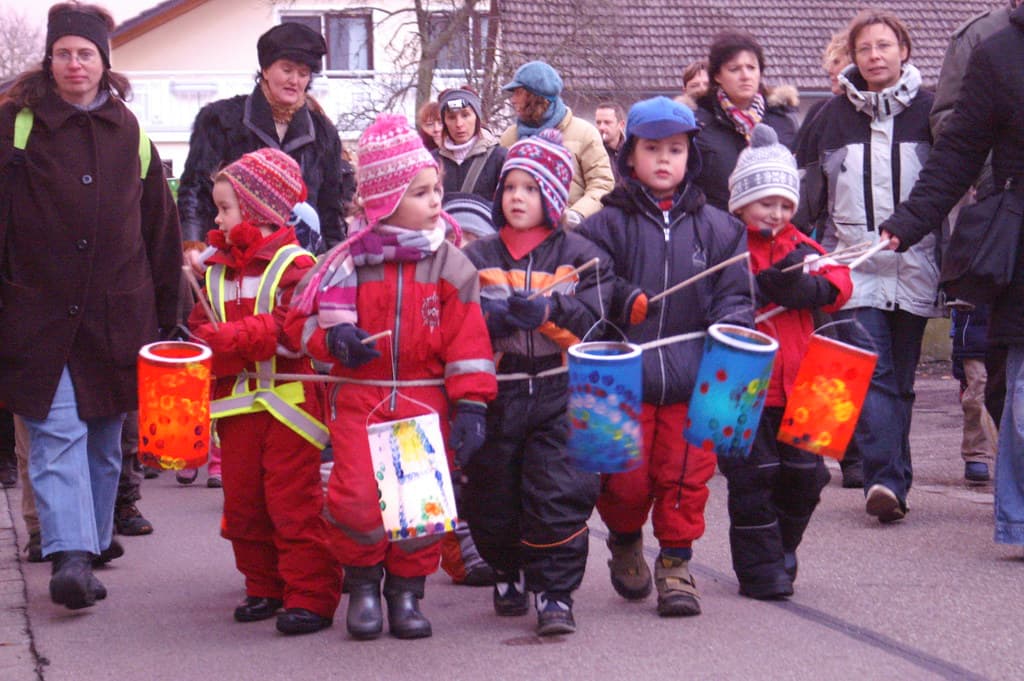
Children with homemade lanterns on a St. Martin's walk
Photo by Bux / flickr · CC BY 2.0
What to expect
There is no single event. Instead, processions take place in neighborhood after neighborhood, usually on several evenings around November 11.
Early November
Lantern season
Schools, kindergartens and parishes hold their own processions on different evenings. Bakeries sell Weckmann, sweet dough figures with a clay pipe, and goose appears on restaurant menus.
Nov 10
Martin's Eve
Some towns hold their main procession on the eve of the feast, with a rider, bands, lanterns and a large bonfire at the end of the route.
Nov 11
The feast day
More processions, Dutch and Flemish children knocking on doors with lanterns, and in Cologne and other Rhineland cities, the carnival season opening at 11:11 in the morning. Cologne Carnival proper comes months later.
Planning your trip
Getting there
The Rhineland is the heartland of the lantern processions, and cities such as Cologne, Düsseldorf and Bonn make easy bases, linked by regional trains. Smaller towns on the Lower Rhine, including Kempen, hold some of the largest and most traditional processions, and Bocholt, just across in Westphalia, runs a big schoolchildren's procession. In the Netherlands, Utrecht is the natural base for Sint-Maarten, with a city parade that starts at the Domplein in the early evening.
Because most processions begin at dusk, you can fit a daytime city visit around one. Mid-November also overlaps with the opening of Christmas markets: Vienna Christkindlmarkt opens on a Friday in mid-November, and Nuremberg Christkindlesmarkt follows on the Friday before the first Sunday of Advent.
Where to stay
November is outside the main tourist season in this part of Europe, so rooms are usually easier to find than in summer, with one exception: in Cologne, Düsseldorf and Mainz, November 11 is also the official start of carnival season.
What it costs
Watching a procession is free, since these are community events with no tickets. Your spending will be a bakery Weckmann, a warm drink from a stall and, if you go for the traditional dinner, a restaurant Martinsgans. We have no sourced prices for these, so check menus locally.
Go like you know
- Buy a Weckmann or Stutenkerl from a bakery and eat it warm, the way local children do after the procession.
- Book a table for Martinsgans, the traditional roast goose dinner, which restaurants serve throughout November.
- Learn the chorus of "Ich geh mit meiner Laterne", a classic lantern song. Parents in the crowd will be singing it.
- Bring a simple lantern if you travel with children. Many shops sell paper lanterns and battery lights in early November.
- In Cologne, combine an evening procession with the carnival opening on the morning of the eleventh for two very different traditions in one day.
Frequently asked questions
Where are the biggest St. Martin processions?
The Lower Rhine has some of the largest. Kempen has been reported to draw around 4,000 marchers, and Bocholt, in Westphalia, a procession of up to 3,000 schoolchildren. Cities such as Cologne and Düsseldorf hold many neighborhood processions rather than one huge one. In the Netherlands, Utrecht holds a city parade for its patron saint.
Is St. Martin's Day a public holiday?
Not in most places. Schools, shops and offices generally stay open, and processions happen in the evening. The exception is Burgenland in Austria, where Martin is the patron saint and November 11 is a state holiday with schools closed. The Cologne 11:11 carnival opening is not a holiday either.
Can tourists join a lantern procession?
You are welcome to watch, and families with children sometimes walk at the back with their own lanterns, especially at larger town processions. For school and kindergarten processions, which are smaller and private in spirit, it is better to watch from the side.
What is the connection with carnival?
The two simply share a date. In the Rhineland, carnival season officially opens on November 11 at 11:11, a tradition linked to the number eleven's playful symbolism. The lantern processions are a separate, much older religious custom, but in Cologne you can easily see both on the same day.