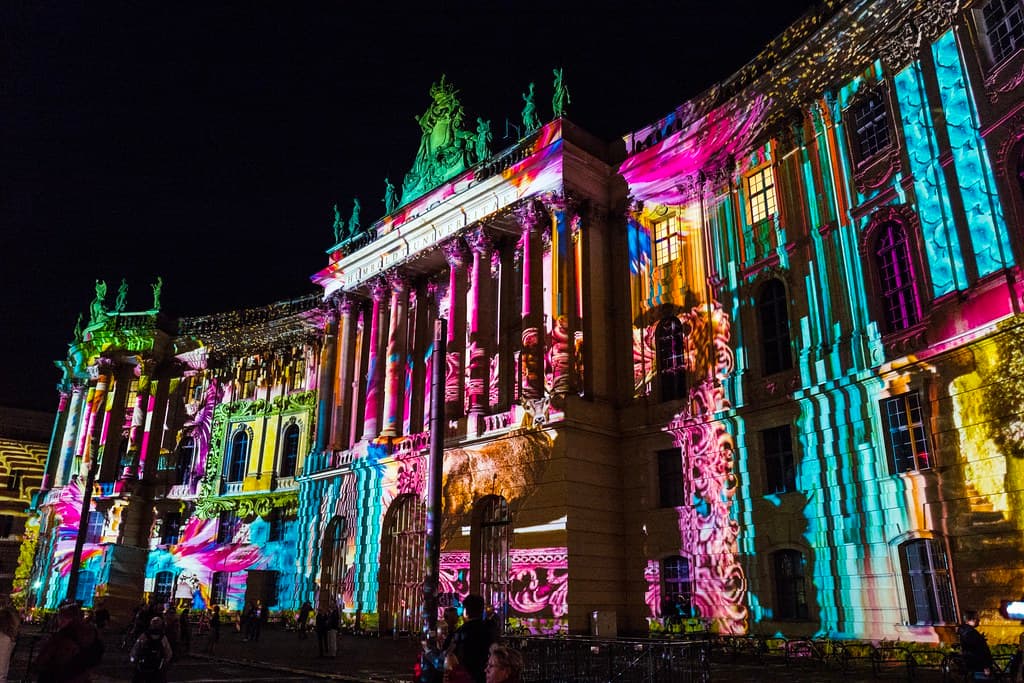
What is the Festival of Lights?
Every October since 2005, Berlin has turned its landmarks into screens. For eight to ten evenings, artists from around the world project animations, light art and video mapping onto dozens of buildings: the Brandenburg Gate, the Berlin Cathedral, the TV Tower, the Victory Column, museums, churches and bridges. The facades come alive with color and motion, and the city fills with people walking, cycling and riding from one site to the next.
The festival was founded by the creative director Birgit Zander and has grown into one of the largest light-art events in the world, drawing millions of visitors over its run, according to the organizers. Each edition has a theme, and the program mixes commissioned works with competition entries, including a World Championship of Projection Mapping that brings video artists from many countries to compete on Berlin's buildings.
Most of the festival is simply free and public. You do not need a ticket to stand in front of the cathedral and watch it change color, and many Berliners treat it as an excuse for an evening walk through their own city. Concerts, guided tours and other extras are ticketed for those who want more.
For these October nights, the city's history becomes a canvas.
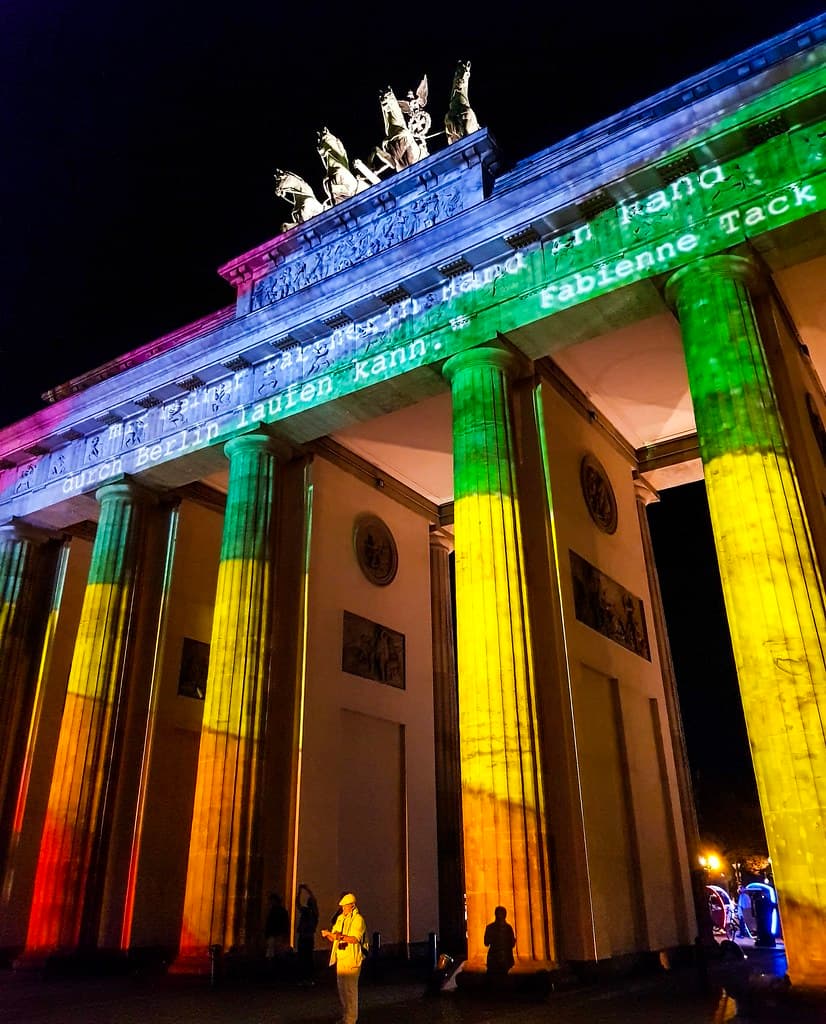
The Brandenburg Gate in festival colors, the most photographed site of the run
Photo by Sergey Galyonkin / flickr · CC BY-SA 2.0
What to expect
The installations switch on at around 7 p.m. and run until about 11 p.m. every evening, so you can design your own route. The list of sites changes every year, so treat the routes below as a template and check this year's official map.
Night one
The big landmarks
Start at the Brandenburg Gate and walk east along Unter den Linden to the Berlin Cathedral and Museum Island. This route usually covers several of the most spectacular projections in a single evening.
Night two
Alexanderplatz and the east
Head to the TV Tower at Alexanderplatz and the old churches nearby, then take the train to whichever bridges and riverside sites are lit over the Spree that year.
Night three
West and the extras
Visit the Victory Column and sites in the west of the city, or book a concert, a boat ride or a guided Lightseeing tour by bus, boat or on foot to see the far-flung locations.
Planning your trip
Getting there
Berlin is one of Europe's easiest cities to reach, with direct flights from around the world, a central rail station with fast trains to other German and European cities, and excellent public transport. The festival sites are spread across the city, but the most famous ones are close to S-Bahn and U-Bahn stations, and the official map shows them all. Parking in central Berlin is difficult, so leave the car behind.
In 2026 the opening weekend (October 9 to 11) overlaps the last days of Stuttgart's Cannstatter Volksfest, so the two can share one October trip across Germany.
Where to stay
Stay somewhere central, such as Mitte or Kreuzberg, so you can walk or cycle between sites and get back easily after the projections switch off. Hotels are busier during the festival weekends, so book ahead, especially if you want a central base on a Friday or Saturday.
What it costs
The light art itself is free. Extras are ticketed: the Festival of Lights in Concert at the Berlin Cathedral (October 13 to 17 in 2026) starts at €60, and guided Lightseeing tours by boat, bus or on foot are priced by operator, generally from the low €20s to around €40. Street food is cheap and everywhere.
Go like you know
- Rent a bike or use the city's bike-share. The sites are spread out, and cycling between them can be quicker than public transport and part of the fun.
- Go late. Crowds thin after about nine, and the projections run until the end of the evening.
- Pick up the official map or app before you start, because the list of sites changes every year.
- Warm up with a hot drink or a currywurst from a street stand between sites. Berlin's night food is cheap and everywhere.
- If you like light festivals, Lyon's Fête des Lumières follows in early December.
- Look for the smaller, less famous locations. Some of the most daring projections are on buildings few tourists visit.
Frequently asked questions
Is the Festival of Lights free?
Yes. All of the outdoor projections are free to see, and you can walk up to any site without a ticket. You pay only for optional extras, such as concerts, boat trips and guided tours by bus or on foot that take you between several locations with commentary.
How many nights do I need?
Two or three evenings let you see most of the major sites without rushing. One night is enough for the central route from the Brandenburg Gate to Museum Island and Alexanderplatz. If you want to see everything, including the outlying locations, a guided tour on one night saves time.
What is the best time to go each evening?
The projections start at dusk. Early in the evening is the most crowded time at the big landmarks, especially at weekends. Locals often head out later, after dinner, when there is more space to stand and watch the full show, which is ideal for photographs too.
Can I combine it with other things in Berlin?
Easily. Spend your days in museums, galleries and neighborhoods, and your evenings on the light trail. October is a good time for Berlin in general: the city is lively, the autumn colors are out in the parks, and theaters and concert halls are in full season.