What is the Guelaguetza?
The Guelaguetza is Oaxaca's great summer festival of dance. The word is Zapotec and is usually translated as the reciprocal exchange of gifts and services, the custom of giving to your neighbours in the knowledge they will give to you. The festival turns that idea into a celebration of the state's many peoples: every July, delegations from Oaxaca's eight regions come to the capital to perform their dances, music and dress for each other and for visitors.
Its roots are much older than the stage. Before the Spanish arrived, the people of the Oaxaca valleys held ceremonies in July for the maize harvest and the gods of corn, and those rites later blended with Catholic feasts, especially that of the Virgen del Carmen on July 16. In the 20th century the state reorganized the celebrations into a single festival on the Cerro del Fortín, the hill above the city, and since 1969 it has been held on the two Mondays after July 16, which is why locals still call it Los Lunes del Cerro, the Mondays on the Hill.
The festival has also been contested. Critics have long argued that it has become a commercial show, and in 2006, during a political crisis in the state, teachers and social movements staged a free alternative, the Guelaguetza Popular. Versions of it still take place alongside the official festival in some years.
What to expect
The main performances take place in the open-air Auditorio Guelaguetza on the Cerro del Fortín, but the whole city is in festival mood for most of July, with parades, concerts, food fairs and markets.
Before the Mondays
Parades and the goddess
Delegations parade through the historic centre in a convite with brass bands, giant puppets and mezcal, and the Diosa Centéotl, a young woman chosen to represent the festival, is named from among candidates from all eight regions.
First Monday
Lunes del Cerro
Morning and evening performances in the auditorium. Each delegation takes the stage for a few minutes, introducing its region, dancing, and at the end throwing gifts from home into the crowd: fruit, bread, small crafts.
Second Monday
The octava
The second round, a week later, with a similar programme. Between the two Mondays the city hosts the mezcal fair, food festivals and concerts.
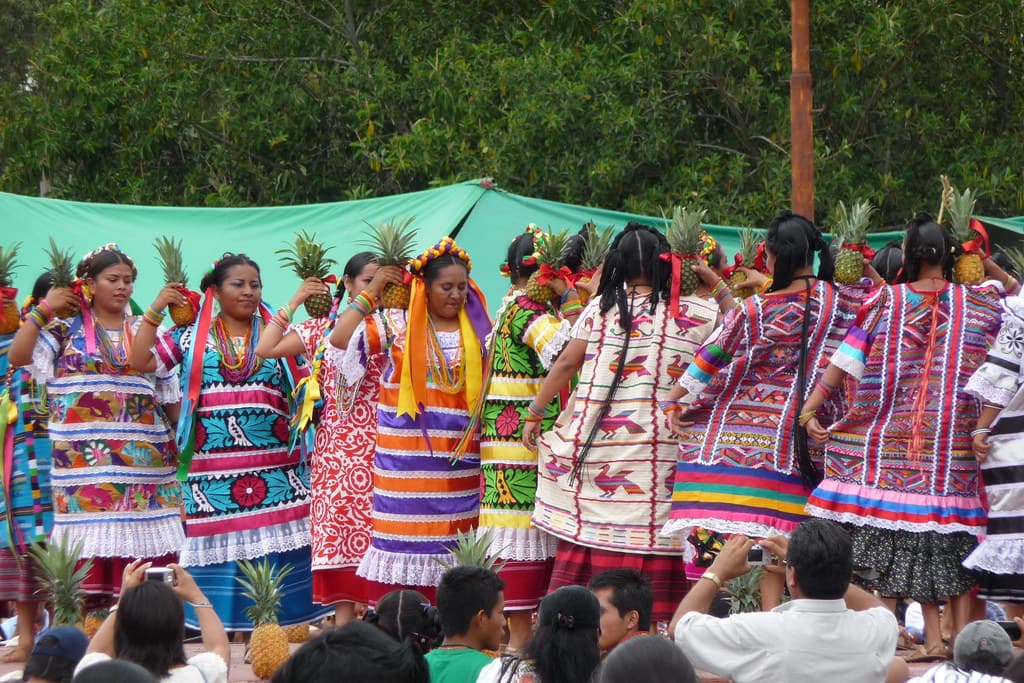
Two dances are the favourites. In the Danza de la Pluma from the Central Valleys, men in huge circular feathered headdresses re-enact the conquest of Mexico in leaps and turns. In the Flor de Piña, from the Papaloapan basin, women in richly embroidered huipiles dance with pineapples on their shoulders, a dance many visitors remember as the image of the whole festival.
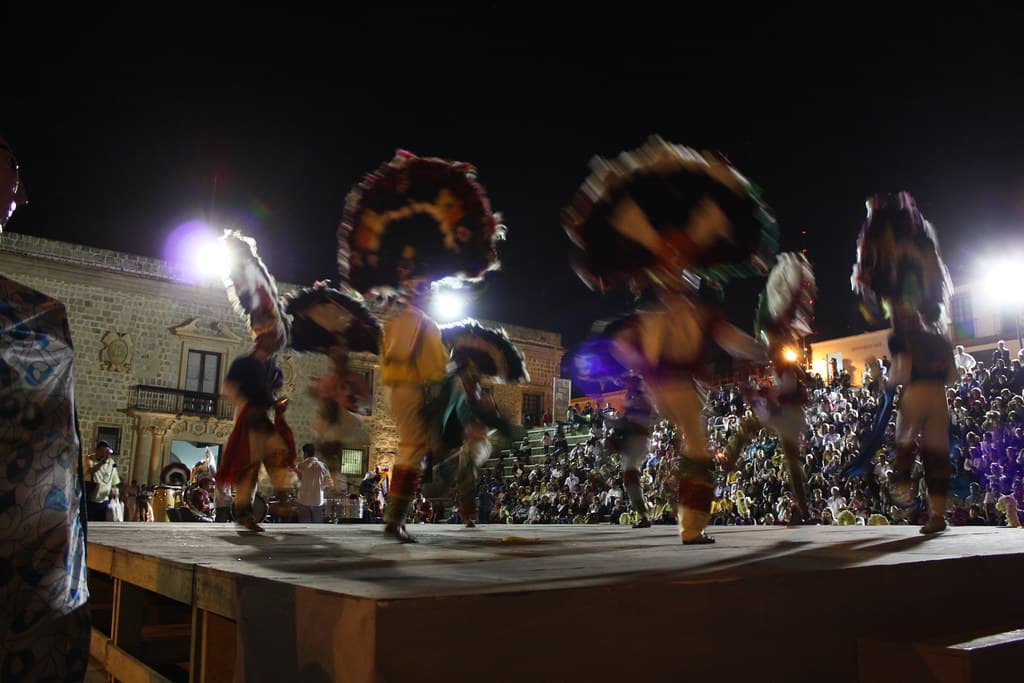
Danza de la Pluma dancers in their feathered headdresses
Photo by linkogecko / flickr · CC BY-SA 2.0
Planning your trip
Getting there
Oaxaca's airport has direct flights from Mexico City and several other Mexican cities, and buses from Mexico City take about six to seven hours. The auditorium is a steep walk up the Cerro del Fortín from the centre; on performance days there are shuttles and taxis, but traffic is heavy.
Where to stay
The historic centre, around the zócalo and Santo Domingo, puts you close to the parades, restaurants and the walk up the hill. Rooms fill weeks ahead for both Mondays, and prices rise. Jalatlaco and the neighbourhoods just north of the centre are quieter alternatives within walking distance.
What it costs
Two of the auditorium's four seating sections are free. In 2026 the reserved boxes cost about 1,300 and 1,600 pesos. The parades, fairs and many concerts are free, and Oaxaca's food is famously good value, from market tlayudas to moles. Rooms are the main cost in festival weeks.
Go like you know
- Catch the gifts. When a delegation throws fruit or bread into the crowd, it is the guelaguetza in action, a gift from that region.
- Try the mezcal, but take it slowly: the parades offer it freely, and the Oaxaca altitude adds to its kick.
- Learn which region each delegation comes from. The announcer introduces them, and the differences in dress and music between the coast, the mountains and the valleys are the point.
- Oaxaca's other great festival is Día de Muertos in November, when its markets and cemeteries fill with marigolds.
- For a great Andean festival of regional dance, see Puno's Fiesta de la Candelaria or Bolivia's Carnaval de Oruro.
Frequently asked questions
When is the Guelaguetza?
On the two Mondays after July 16, unless the first falls on July 18, the anniversary of Benito Juárez's death, in which case both move a week later. In 2026 the Mondays were July 20 and 27; in 2027 they are expected to be July 19 and 26. Events run across the city for most of July.
How do I get tickets?
Tickets for the reserved boxes go on sale online in early June and sell out fast. Two of the auditorium's four sections are free, first come first served, and people queue from the night before. If you miss out, the parades and many concerts in the city are free and well worth it.
Is the Guelaguetza authentic or a show for tourists?
Both, and Oaxacans debate it themselves. The auditorium performances are staged and shortened, but the delegations come from real communities, the dances and dress are their own, and the festival is hugely popular with Oaxacans. Pair it with a village fiesta to see dances in their home setting.