What is Calcio Storico?
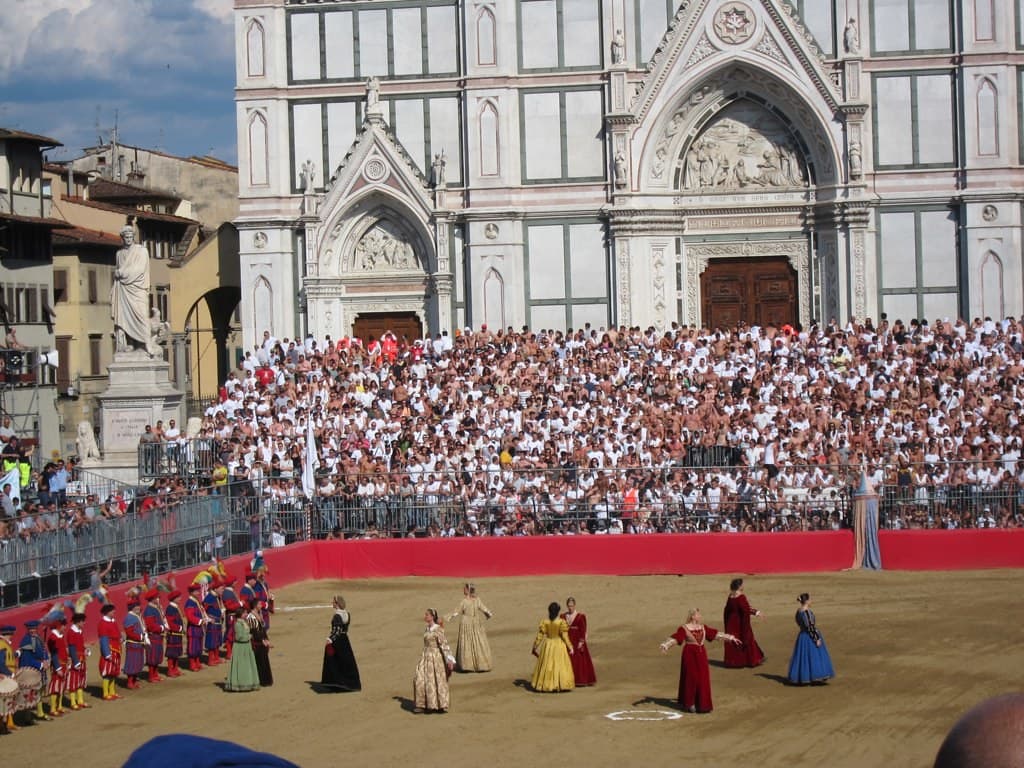
Calcio storico, historic football, is Florence's own game, and it looks nothing like the modern sport. Each June, the great square in front of the basilica of Santa Croce is covered with sand and ringed with grandstands, and two teams of 27 men each fight for 50 minutes to carry, throw or punch their way to scoring. Wrestling, tackling and fist fights are part of the play. It is often described as a mixture of football, rugby and wrestling, and it is famously rough.
The game has Renaissance roots. Florentines played a form of it in the city's squares for centuries, and its rules were written down in the late 16th century. Its most famous match was played in February 1530, when Florence was besieged by imperial troops and the citizens played in Piazza Santa Croce in defiance of the army camped outside. The modern tournament revives that tradition.
Four teams play, one for each historic quarter of the city: the Azzurri of Santa Croce, the Bianchi of Santo Spirito, the Rossi of Santa Maria Novella and the Verdi of San Giovanni. Loyalty runs deep, and the whole city takes sides. Players must be born in Florence or have lived there for years, so every team is truly local.
What to expect
The tournament is just three matches: two semifinals in mid-June and the final on June 24, the feast of St John the Baptist, Florence's patron saint.
Semifinals
Two matches in mid-June
The four teams, drawn in pairs, play their semifinals on two evenings in the second or third week of June. In 2026 they were played on June 13 and 14, starting in the early evening.
Every match
The parade
Before each match, a historic parade, the corteo storico, of hundreds of people in Renaissance costume, with drummers, flag throwers and soldiers, winds through the city to the square and onto the pitch.
June 24
The final
The two winning teams meet in the final on St John's Day, also a public holiday in Florence, which ends that night with fireworks over the Arno.
Goals are called cacce, and the teams switch ends after each one. A shot that misses the net and flies over it gives the other team half a point. Since there are no substitutions, a team that loses players to injury or expulsion plays on short-handed. The winning team once received a Chianina cow; today it wins the honour, and a dinner.
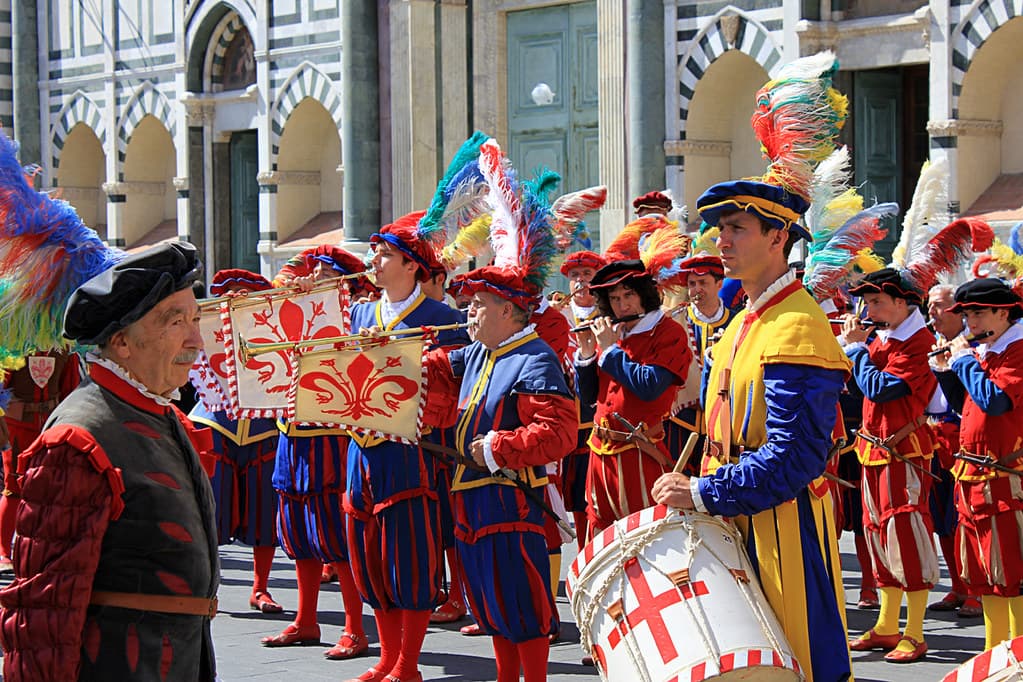
Drummers in the historic parade before the calcio storico final
Photo by Jon Gonzalo Torróntegui / flickr · CC BY 2.0
Planning your trip
Getting there
Florence's airport has flights from across Europe, and Santa Maria Novella station has fast trains from Rome, Milan and Venice. Piazza Santa Croce is in the historic centre, about fifteen minutes' walk from the station and from the Duomo.
Where to stay
The historic centre has hotels and apartments at every price, though June is high season and prices are high. The neighbourhoods around Santa Croce and Sant'Ambrogio put you close to the square, and Oltrarno, across the river, is home to the Bianchi's supporters.
What it costs
Tickets for the grandstands are limited, sold through the city's official channels, and go quickly; some of the best seats are reserved. The parade and the St John's Day fireworks are free. Florence is expensive in June, so rooms will be the main cost.
Go like you know
- Pick a colour and wear it, but think twice before cheering for one team in the other's section.
- See the fireworks over the Arno on the night of June 24 from the Lungarno or Piazzale Michelangelo.
- Book tickets as soon as the sale opens; the stands hold only a few thousand.
- Siena's Palio, on July 2, is the other great contest between the quarters of a Tuscan city.
- Pamplona's San Fermín follows in July, if you're looking for another festival of risk and tradition.
Frequently asked questions
When is calcio storico?
Every June. The two semifinals are played on two evenings in mid-June, and the final is always on June 24, St John's Day. In 2026 the semifinals were on June 13 and 14. The city announces the year's schedule and the draw in the spring.
How do I get tickets?
Through the official ticket sales announced by the city of Florence, usually a few weeks before the tournament. The stands around the square hold a limited number of spectators, and tickets sell out quickly, especially for the final. Avoid unofficial resellers.
Is it really that violent?
Yes. Punching, wrestling and tackling are part of the game, within rules that ban the most dangerous moves, such as kicks to the head. Players are often injured, and the organizers have tightened the rules after past brawls. It is not a match to take young children to.