What is the Aoi Matsuri?
Kyoto has three great festivals: the Gion Matsuri in July, the Jidai Matsuri in October, and, oldest of all, the Aoi Matsuri on May 15. Its roots go back to the reign of Emperor Kinmei in the 6th century, when, according to Japan's ancient chronicles, rituals were held to calm the gods of the Kamo shrines after a time of disaster and bad harvests. In the Heian period, when Kyoto became the capital, it became an imperial festival, and for centuries it was simply called "the festival".
Its name comes from the aoi leaves, often translated as hollyhock, that decorate everything in the procession: the costumes, the ox carts, the hats of the participants. The plant was believed to protect against disaster, and was associated with the two Kamo shrines, Shimogamo and Kamigamo, which the festival honours. Both are among Kyoto's oldest shrines and are now UNESCO World Heritage sites.
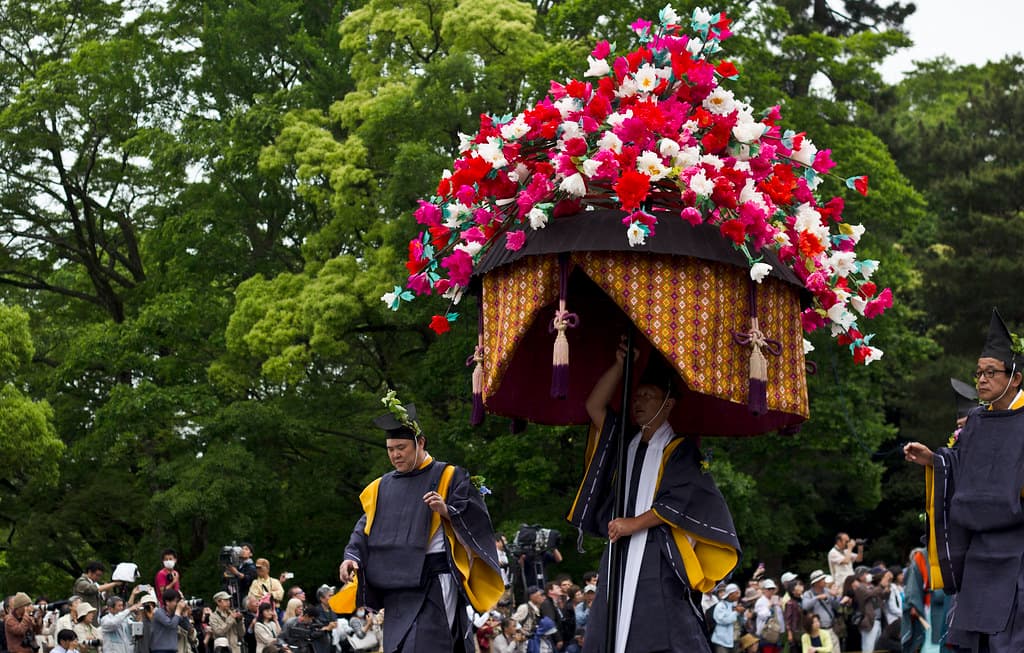
The festival today is a procession, recreating the journey of the imperial messenger who carried the emperor's offerings to the shrines. Hundreds of people in the costumes of the Heian court walk at a stately pace from the Kyoto Imperial Palace to Shimogamo and then on to Kamigamo: officials on horseback, attendants carrying parasols covered in flowers, ox carts hung with artificial wisteria, and women of the court.
Its star is the Saiō-dai, a young woman chosen each year to play the role of the imperial princess who once served the Kamo shrines. She wears the jūnihitoe, the twelve-layered robes of the court, and is carried in a palanquin, in the style of the Heian court. Unlike the lively Gion Matsuri, the Aoi Matsuri is quiet and elegant, closer to a moving picture scroll than a party.
What to expect
The procession takes most of the day on May 15, covering about 8 kilometres in two stages.
Morning
The Imperial Palace
At 10:30, the procession leaves the Kyoto Imperial Palace through its southern gate and walks through the palace park, then east towards the Kamo River, reaching Shimogamo Shrine at around 11:40.
Midday
Shimogamo Shrine
At Shimogamo, the imperial messenger reads the emperor's message to the gods and offerings are made, in rites performed in the shrine grounds. The procession rests before setting off again.
Afternoon
To Kamigamo
In the early afternoon, the procession walks north along the Kamo River to Kamigamo Shrine, arriving at around 3:30pm for the final rites of the day.
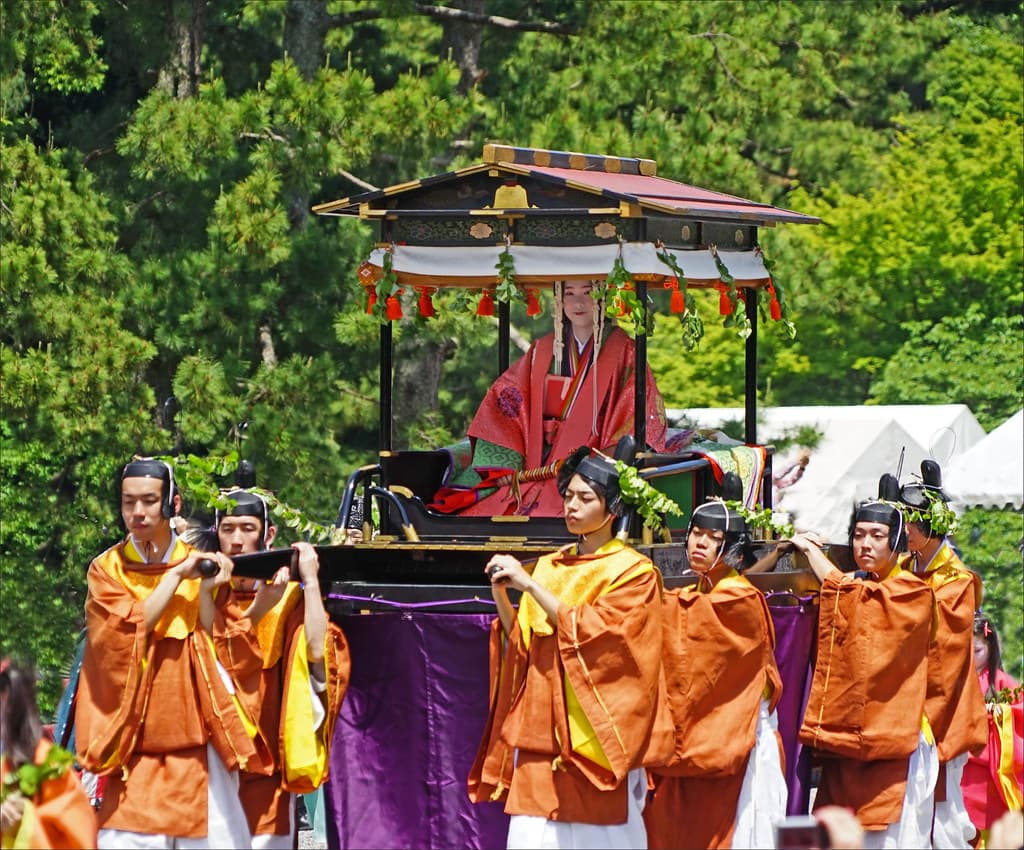
The Saiō-dai's palanquin in the Aoi Matsuri procession
Photo by dalbera / flickr · CC BY 2.0
Planning your trip
Getting there
Kyoto is about two hours and 15 minutes by shinkansen from Tokyo, and about 75 minutes by train from Kansai International Airport, near Osaka. The Imperial Palace is near Imadegawa and Marutamachi stations on the Karasuma subway line, and Shimogamo Shrine is a short walk from Demachiyanagi station.
Where to stay
Kyoto has hotels, ryokan and guesthouses for every budget. The area around Karasuma, near the palace, and the streets of central Kyoto are convenient for the festival. May is busy but usually less so than the cherry blossom season and autumn, so rooms are easier to find.
What it costs
Watching the procession is free. Paid seats are sold at the Imperial Palace and at Shimogamo Shrine, which guarantee a view and a place in the shade. Kyoto can be expensive in high season, but in May, rooms and food are reasonably priced.
Go like you know
- Book paid seats if you want a guaranteed view at the palace, where the procession is at its most impressive against the open park.
- Look out for the pre-festival events in early May, such as horse racing at Kamigamo and mounted archery at Shimogamo.
- Visit both shrines on a quieter day; Shimogamo's forest is beautiful in spring.
- Kyoto's other great festival is the Gion Matsuri, in July, with its giant floats.
- Tokyo's Kanda Matsuri, also in May, is one of the capital's great shrine festivals.
Frequently asked questions
When is the Aoi Matsuri?
Every year on May 15, starting at 10:30 from the Kyoto Imperial Palace. In 2027, May 15 is a Saturday, so expect larger crowds than on a weekday. If it rains, the procession is postponed to the next day, May 16.
What does "aoi" mean?
Aoi is the name of the heart-shaped leaves that decorate the procession, usually translated as hollyhock, though the plant is probably closer to wild ginger. It was believed to ward off disaster, and it is the symbol of the Kamo shrines.
Who is the Saiō-dai?
The Saiō-dai is a young woman from Kyoto chosen each year to stand in for the Saiō, the imperial princesses who once served as high priestesses of the Kamo shrines. She wears twelve layers of court robes and is carried in a palanquin, and she is the most photographed figure of the day.