What is Yeon Deung Hoe?
Yeon Deung Hoe (연등회), the Lotus Lantern Festival, is held in Seoul in the weeks before Buddha's Birthday, the eighth day of the fourth lunar month. Its origins go back more than a thousand years to the Silla and Goryeo dynasties, when lantern-lighting ceremonies were held to honor the Buddha and pray for the nation. Buddhists elsewhere mark the same anniversary at Vesak, which at Waisak at Borobudur in Central Java means monks walking from Mendut to Borobudur on a full-moon day in May or early June.
Lighting a lantern in Buddhism symbolizes bringing light to the world, dispelling the darkness of ignorance. During the Joseon dynasty, when Confucianism became the state ideology, the state-run Buddhist lantern festival was discontinued, but lantern lighting survived as a popular folk custom. In modern times, Yeon Deung Hoe was revived as a large public festival, and in 2020, UNESCO inscribed it as intangible cultural heritage.
Today, the festival brings together Buddhist temples, communities and the public in a celebration of light and joy. It centers on Jogyesa, the head temple of the Jogye Order of Korean Buddhism, in central Seoul, and on Jongno, where the main parade takes place.
One small light for every wish, and a whole city carrying them together.
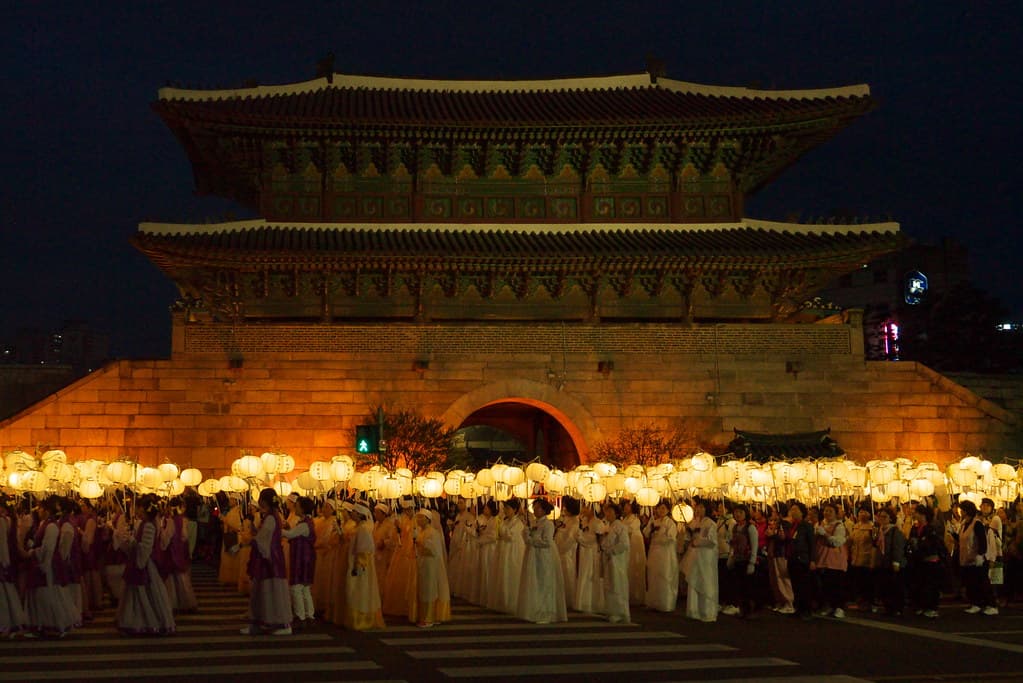
Lantern-carrying procession in hanbok in front of a historic gate
Photo by travel oriented / flickr · CC BY-SA 2.0
What to expect
The festival takes place over a weekend, with events before and after.
Before
Lantern exhibitions
Lantern displays appear in central Seoul in the weeks before the weekend, at Jogyesa Temple and Bongeunsa among other places, and temples across the city hang lanterns in their courtyards.
Saturday afternoon
Eoullim Madang
A festive gathering with performances and dances at Dongguk University, where the parade begins, warms up the crowd.
Saturday evening
Lantern parade
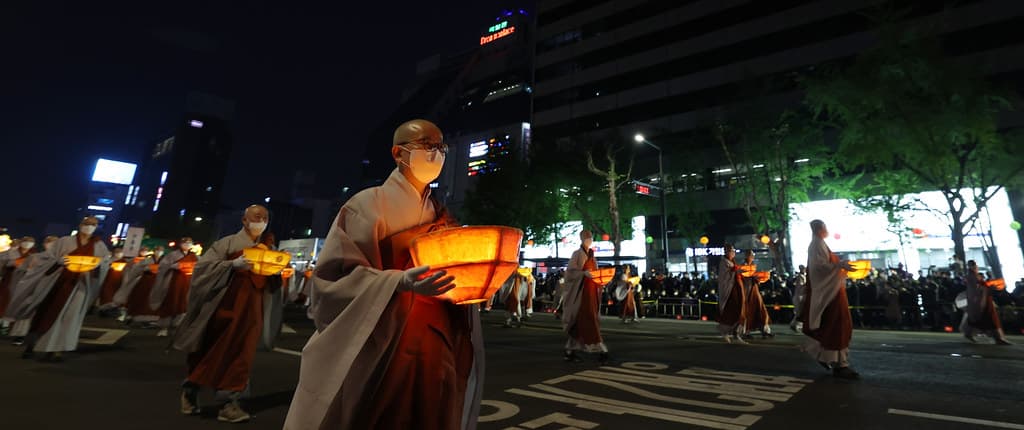
The main event: a lantern parade that starts at Dongguk University, passes Heunginjimun Gate and follows Jongno to Jogyesa Temple. Seoul city has put the turnout at about 60 organizations and 20,000 participants, carrying giant lanterns and handheld ones. An after-party, the Daedong Hanmadang, follows in the Jongno area.
Sunday
Traditional culture street festival
The area around Jogyesa becomes a street fair with lantern making, temple food, crafts and performances, followed by an evening lantern procession through Insadong.
Planning your trip
Getting there
Seoul is easy to reach, with Incheon International Airport connected to the city by the AREX airport rail, roughly 45 minutes to an hour to Seoul Station depending on the service. The festival area around Jongno, Insadong and Jogyesa is served by several subway stations, including Jonggak and Jongno 3-ga on Line 1 and Anguk on Line 3.
Seoul's city government phases in vehicle controls on Jongno and Sejong-daero from early afternoon on parade day, and buses are rerouted, so plan to walk the last stretch or ride the subway.
Where to stay
Base yourself near Jongno, Insadong or Anguk to walk to the parade and street fair, or anywhere along subway Line 1 or Line 3. Book early, as May is a busy month in Seoul. After the festival, temples remain decorated with lanterns until Buddha's Birthday, so a stay that stretches past the weekend rewards you with quieter temple visits.
What it costs
Watching the parade from the sidewalks along Jongno is free; arrive early for a good spot. The organizers also offer reserved seating, which you arrange in advance. If you want to join the parade rather than watch it, the festival runs a volunteer and supporter program for international participants with a limited number of places, so check the official website for dates. Lantern making and craft booths on Sunday are free or cost little beyond materials.
Go like you know
- Visit Jogyesa Temple during the festival, when its courtyard is covered by a canopy of lanterns.
- Try temple food at the street festival, simple vegetarian dishes made without garlic or onion.
- Join the after-parade celebration near Jongno, where participants and spectators dance together.
- Visit Bongeunsa in Gangnam or other temples, which hang lanterns in the weeks before Buddha's Birthday.
- Explore Insadong, with its tea houses and craft shops, before the parade.
- Come back on Buddha's Birthday to see temples at their most beautiful.
- Building a longer Korea trip? Spring's lanterns pair well with the summer mud of the Boryeong Mud Festival or autumn's masked satire at the Andong Mask Dance Festival.
Frequently asked questions
When is Yeon Deung Hoe?
The festival takes place on a weekend in the weeks before Buddha's Birthday, which falls on the eighth day of the fourth lunar month, usually in late April or May. The exact dates are announced each year by the festival committee.
Do I need tickets?
No, the lantern parade and street festival are free and open to everyone. Reserved seating along the parade route is offered through the organizers, and some hands-on programs may ask for registration or a small fee for materials. Check the official festival website for current details.
Can foreigners participate in the parade?
Yes. Organizers run a volunteer and supporter program that lets international participants march in the parade, with a limited number of places. Check the official festival website for registration details and dates, and apply early.
What else can I do on Buddha's Birthday?
Visit temples across Seoul, which are decorated with lanterns and hold ceremonies. Many temples offer free meals and tea to visitors. It is a peaceful, joyful day, and a beautiful time to see Korean Buddhist culture.
What do the lantern shapes mean?
Lotus lanterns are the most common, since the lotus, rising clean from muddy water, symbolizes enlightenment. Larger lanterns can take the shape of historical figures, Buddhist symbols or even cartoon characters, and some have moving parts. Temple groups and other organizations design and build many of their own, so no two parades look alike.