What is Teej?
At the end of the monsoon, when the rice fields of Nepal are green, the country turns red. Haritalika Teej, usually simply called Teej, is Nepal's great festival for women. It honours Parvati, the Hindu goddess who, according to legend, fasted and prayed for years until the god Shiva agreed to marry her. Following her example, women fast for the long life and well-being of their husbands, or, if unmarried, for a good husband, and for the happiness of their families.
The festival lasts three days, in the Nepali month of Bhadra, usually in late August or early September. It begins with dar khane din, the day of the feast, when women gather with their families and friends for a lavish meal, dressed in their finest clothes, and sing and dance late into the night. Married women often return to their parents' homes for the festival, and it is a time of reunion and celebration.
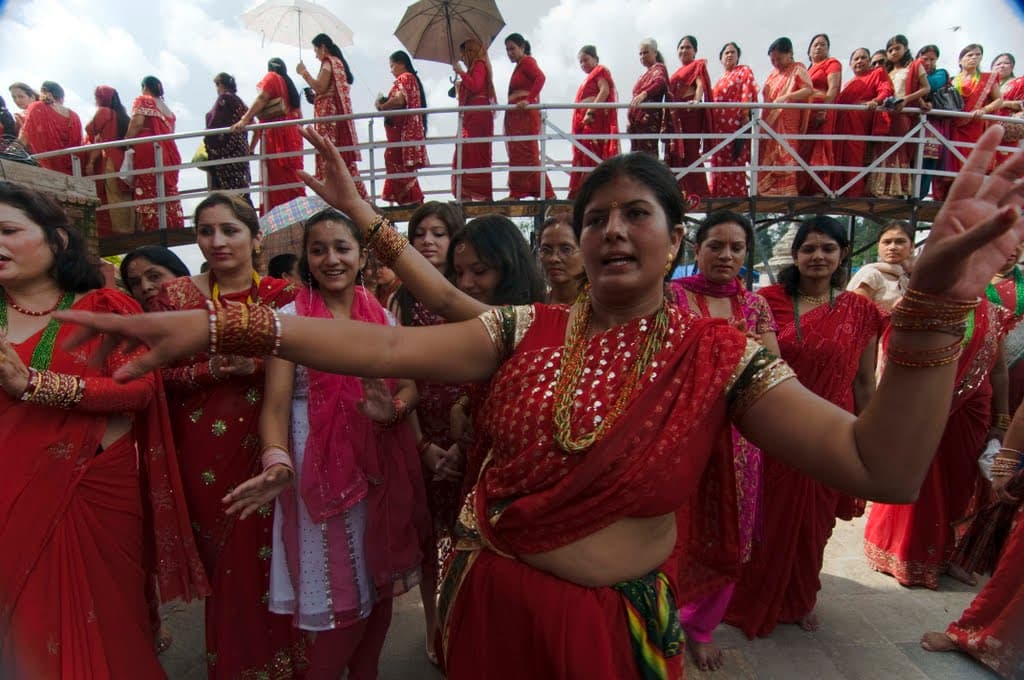
The second day is the day of the fast. Many women go without food or even water for a full day. Dressed in red, green and orange, the colours of marriage, with glass bangles, necklaces of beads and tika on their foreheads, they flock to the temples of Shiva. The most famous is Pashupatinath, the great Hindu temple on the banks of the Bagmati River in Kathmandu, where tens of thousands of women queue for hours to make their offerings, singing and dancing in the temple courtyards. On the third day, Rishi Panchami, women bathe ritually and pray to the seven sages.
Teej songs are an important part of the festival. Traditionally, they expressed women's joys and sorrows, and today many also comment on social issues.
What to expect
The festival lasts three days, with the biggest crowds at Pashupatinath on the second day.
Day one
Dar khane din
Women gather with family and friends for a feast of rich food, then sing and dance late into the evening in homes, community halls and restaurants.
Day two
The fast and Pashupatinath
From early morning, women in red queue at Pashupatinath and other Shiva temples to make offerings, while groups sing and dance in the temple grounds throughout the day.
Day three
Rishi Panchami
Women take ritual baths, often in rivers, and worship the seven sages, bringing the festival to a close.
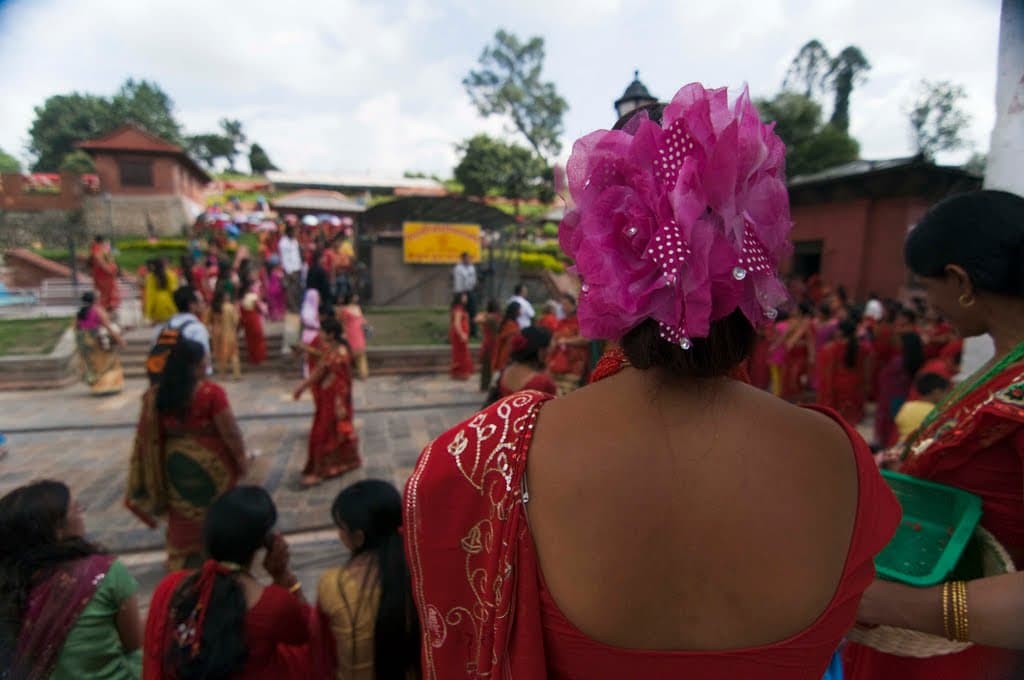
Teej at Pashupatinath, Kathmandu
Photo by 加德满都两年 / flickr · CC BY-SA 2.0
Planning your trip
Getting there
Tribhuvan International Airport in Kathmandu has flights from across Asia and the Middle East. Pashupatinath is a few kilometres east of the city centre, near the airport, and easily reached by taxi. On festival day, roads around the temple are closed, so expect to walk the last stretch.
Where to stay
Thamel, Kathmandu's traveller district, has guesthouses and hotels for every budget. Patan and Boudhanath are quieter alternatives. Teej falls at the end of the monsoon, a quieter season for tourism, so rooms are easy to find and good value.
What it costs
The festival is free to watch. Kathmandu is very affordable, with cheap food and accommodation. Foreign visitors pay an entrance fee to the Pashupatinath area, which goes towards the upkeep of the site.
Go like you know
- Wear red if you want to blend in; many visitors join in the spirit of the day.
- Try the festival foods of the first day, such as sel roti, a sweet rice bread, if you are invited to a feast.
- Listen to the Teej songs, which are sung and danced everywhere during the festival.
- Visit Pashupatinath again on a quieter day to see the cremation ghats and the temple complex at a calmer pace.
- Kathmandu's Indra Jatra, with its living goddess and masked dancers, follows a few weeks later.
- For another great Hindu festival, see India's Ganesh Chaturthi, at the same time of year.
Frequently asked questions
When is Teej?
Teej falls in the Nepali month of Bhadra, usually in late August or early September, and follows the lunar calendar. Nepal's holiday calendars list the main day as September 3, 2027, with the feast the day before, though one guide gives September 1. Check closer to the date.
Can visitors take part?
Yes, respectfully. Visitors are welcome to watch the celebrations, and many women are happy to share their songs and dances. Non-Hindus cannot enter the main Pashupatinath temple, but can watch from the surrounding areas. Dress modestly and ask before taking photographs of people.
Why do women wear red?
Red is the colour of marriage and good fortune in Nepali Hindu tradition. During Teej, women wear red, green and orange saris, with glass bangles and bead necklaces, as a sign of devotion to Parvati and of their wishes for a happy marriage. The temples become a sea of red.