What is the Battle of the Oranges?
Ivrea is a small town in Piedmont, in northern Italy, at the foot of the Alps, about an hour from Turin. Its Carnevale, one of the oldest in Italy, ends with one of the wildest spectacles in Europe: the Battaglia delle Arance, the Battle of the Oranges. For three days, thousands of people on foot fight teams on horse-drawn carts with oranges in the squares of the old town, until the streets run orange with juice and peel.
The battle tells a story. According to legend, in the Middle Ages, a tyrant ruled Ivrea and claimed the right to spend the wedding night with every bride in town. When it was the turn of Violetta, a miller's daughter, she beheaded him and sparked a revolt of the people. Some historians link the story to a revolt against a local lord in the twelfth century. Each year, a young woman of Ivrea is chosen to play the Mugnaia, the miller's daughter, and is presented to the town on Carnival Saturday.
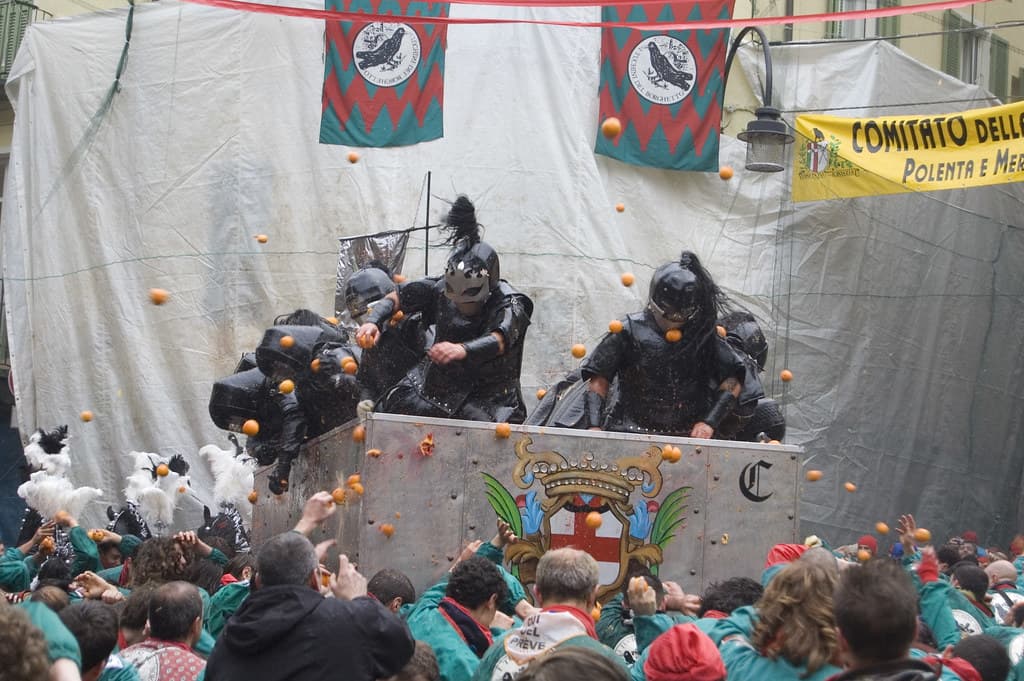
In the battle, the oranges stand for the stones and arrows of the revolt. Nine teams of aranceri on foot, each with its own colours and square, represent the people. They face the throwers on carts, who wear padded armour and masks like helmets and represent the tyrant's guards. The carts are pulled through the squares by horses, and the two sides hurl oranges at each other at close range. Hundreds of tonnes of oranges are thrown every year.
The carnival is much more than the battle. Its programme, overseen by a Generale and his staff in Napoleonic uniforms, includes historic parades, the presentation of the Mugnaia, music and a funeral on the last night, when the carnival is mourned in silence.
What to expect
The carnival runs for several days, with the battle on its last three days, from Carnival Sunday to Shrove Tuesday.
Saturday
The Mugnaia
The Mugnaia is presented to the town from the balcony of the town hall, and the carnival enters its final phase.
Sunday to Tuesday
The battle
From early afternoon, the carts enter the squares and the battle begins, with the aranceri throwing oranges at the carts and the carts throwing back, until the evening.
Tuesday night
The funeral
The carnival ends with a funeral procession, in which the people of Ivrea mourn the end of carnival in silence.
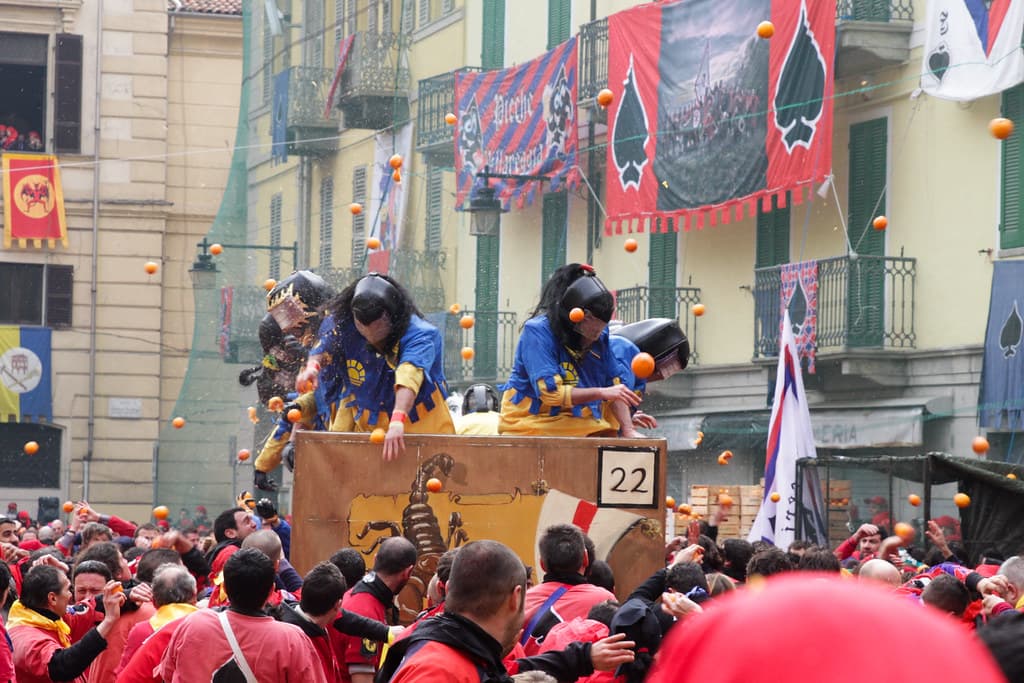
In the thick of the battle in Ivrea
Photo by pigliapost / flickr · CC BY-SA 2.0
Planning your trip
Getting there
Ivrea is about an hour by train from Turin, with direct trains, and reached by road on the A5 motorway. Turin's airport is the nearest, with Milan's airports a little further.
Where to stay
Ivrea has a few hotels, which fill up for carnival. Many visitors stay in Turin and take the train for the day, or in the towns of the Canavese region around Ivrea.
What it costs
Visitors pay a fee to enter the town on Carnival Sunday, about €15 in 2026, with free entry for children and residents. Ivrea and the region are affordable compared with Italy's big cities.
Go like you know
- Buy your red cap as soon as you arrive.
- Arrive early on Carnival Sunday; queues at the town gates can be long.
- Join a team as an aranciere only if you sign up in advance and accept the risks; most visitors watch from behind the nets.
- Try the fagioli grassi, beans cooked in huge pots and served in the squares during the carnival.
- Spain's La Tomatina, in August, is Europe's other great food fight.
- For a calmer carnival, see the masks of the Venice Carnival.
Frequently asked questions
When is the Battle of the Oranges?
On the last three days of the Ivrea carnival, from Carnival Sunday to Shrove Tuesday. The dates follow Easter, so they change every year. In 2027, the battle is expected from February 7 to 9, with the carnival programme starting a few days earlier.
Can visitors throw oranges?
Only if they join a team of aranceri, which requires signing up in advance and accepting the risks. Most visitors watch from behind the nets that protect the squares. Spectators should wear the red cap, which signals they are not taking part, and stay out of the fighting areas.
Why oranges?
The oranges represent the stones and arrows of a medieval revolt against a tyrant, led according to legend by a miller's daughter. Over time, the tradition of throwing objects during carnival turned into a battle with oranges, which became the symbol of the Ivrea carnival.