What is Ati-Atihan?
Ati-Atihan is the fiesta of Kalibo, the capital of Aklan province on the island of Panay, and many Filipinos call it the mother of all Philippine festivals. Its name means "to imitate the Ati", the Indigenous people who lived on Panay long before the lowland settlers.
Local tradition, drawn from the Maragtas epic (whose historical accuracy modern scholars question), tells of Malay datus who arrived from Borneo and bought the lowlands of Panay from the Ati, and of a later famine during which the Ati came down from the mountains and were given food by the lowland settlers. The settlers, the story goes, blackened their faces with soot in imitation of their guests, and danced together in thanks. Over time, after the Spanish brought Christianity to the island, that older celebration became tied to the Santo Niño, the image of the Child Jesus, and the festival became both a religious feast and a carnival.
That double nature defines Ati-Atihan. It is devout, with masses and a great procession, and it is wildly informal: there are organized contests, but the heart of it is open street dancing that tourists and locals join together. It is also the model for many later festivals, including Cebu's Sinulog and Iloilo's Dinagyang.
Hala bira! The shout means "keep going", and for days on end Kalibo does.
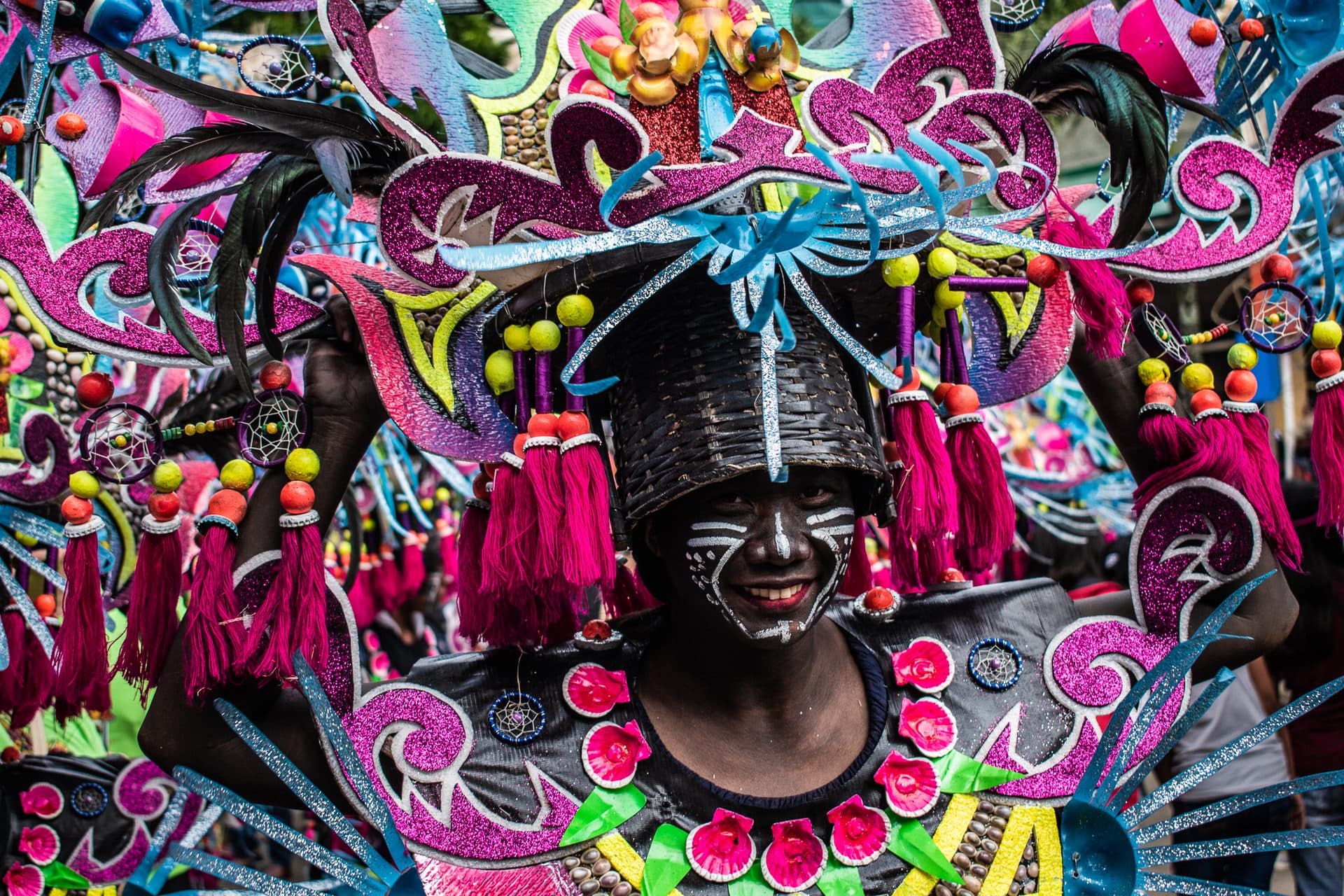
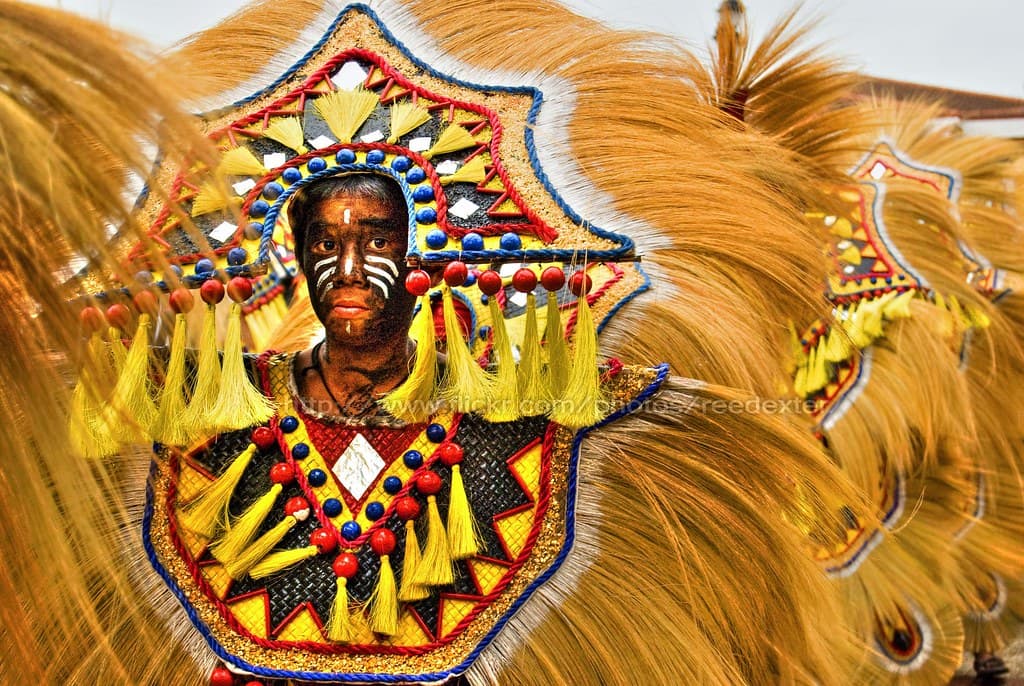
A costumed reveller at the Ati-Atihan festival in Kalibo
Photo by Elisolidum / wikimedia · CC BY-SA 4.0
What to expect
The festival builds through the week and peaks over the final weekend.
Early week
Opening and community events
Daily novena masses, visits by the Santo Niño image to neighborhoods, and smaller parades by schools and local groups begin the festival.
Mid-week
Building the rhythm
Drum groups and tribes practise and perform in the streets in the evenings, giant papier-mâché figures (higante) parade through town, and the streets fill with visitors from around the country.
Saturday
Sadsad contests
Tribal groups compete in costume and choreography, and the open street dancing, the sadsad, goes on for hours, often well into the night.
Third Sunday
Procession and the final day
A high mass and a long procession honoring the Santo Niño, with devotees carrying images of the Holy Child, followed by more dancing until the festival winds down.
Planning your trip
Getting there
Kalibo has its own airport, with domestic flights from Manila and a few international routes. Many visitors combine the festival with Boracay, roughly two to three hours away by road to the Caticlan jetty plus a short ferry, and travel in for the main days. Sinulog in Cebu is held the same third Sunday of January, so you will need to choose between the two.
The festival is concentrated in the compact town center around the cathedral and the main roads. Everything is walkable, and that is just as well, because traffic stops when the drum groups move through. For the 2026 edition, police announced temporary mobile-signal jamming around the Sunday morning mass and procession, so agree a meeting point with your group before you head out.
Where to stay
Rooms in Kalibo itself are limited and book out well in advance, so reserve as soon as your dates are firm. If the town is full, base yourself in a neighboring town or on Boracay and commute in for the main days, allowing time for festival traffic and road closures.
What it costs
Watching and joining the street dancing costs nothing; the festival is free and open. The spending is on rooms, which carry a festival premium in Kalibo, and on small things: tricycle rides, street food and water. Some guides report hotels asking for minimum stays over the peak weekend, so check when you book.
Go like you know
- Wear light clothes you do not mind ruining. Soot, paint and sweat are part of the experience.
- Bring earplugs if you are sensitive to noise. The drums are extraordinary and relentless.
- Try inubarang manok, a chicken dish cooked with banana pith, a specialty of Aklan.
- Pace yourself through the weekend. Many groups dance late into the night, and Sunday opens with an early high mass.
- After the festival, slow down on Boracay or the quieter beaches of Aklan and Antique. Planning a longer Philippine loop? The Kadayawan Festival in Davao City, in August, is another celebration rooted in Indigenous communities.
- Arrive in Kalibo a day or two early to watch the drum groups rehearse in the evenings; it is the best way to hear the rhythms before the crowds arrive.
Frequently asked questions
Can tourists take part in Ati-Atihan?
Yes. Ati-Atihan is known for being open: tourists can join the street dancing, follow drum groups and share the celebration with locals. Competitive performances are for registered tribes, but the street party around them welcomes everyone. Be respectful during the religious processions and masses.
When is the best time to arrive?
The final weekend, culminating on the third Sunday of January, is the peak. Arriving on Friday lets you settle in, experience Saturday's sadsad contests and street dancing, and attend Sunday's procession. Earlier in the week is calmer and good for seeing preparations.
How does Ati-Atihan relate to Sinulog?
Both honor the Santo Niño in January, and Ati-Atihan is often described as the older festival that inspired others, including Sinulog in Cebu and Dinagyang in Iloilo. Ati-Atihan is smaller, looser and more participatory; Sinulog is bigger and more choreographed.
Where should I stay?
Kalibo has a small number of hotels and guesthouses that fill quickly, so book early. Alternatively, stay on Boracay or in nearby towns and travel in for the main days, allowing time for festival traffic and road closures in Kalibo itself.
What should I bring?
Pack light, breathable clothes you can ruin, sandals or shoes you can dance in, sunscreen and a refillable water bottle. A small waterproof pouch protects your phone from sweat, soot and spilled drinks. Earplugs help with the drums, and a little cash for street food and tricycle rides goes a long way.